Chris N. Lesser (University of North Carolina at Charlotte)
“…every image of the past that is not recognized by the present as one of its own concerns threatens to disappear irretrievably.” — Walter Benjamin (1968: 255)
In May of last year, Kleber Mendonça Filho’s latest film O Agente Secreto (The Secret Agent) won laurels for Best Director and Best Actor (Wagner Moura) at Cannes. It premiered in Brazil in November, topping box office sales for weeks. As Mendonça Filho explains in a preface to the published script (2025), the screenplay acquired a life of its own as he quarantined, in his childhood home in Recife, in the neighborhood of Setúbal, a place intimately familiar to those acquainted with his filmography. The three-room apartment—suite, living, kitchen/dining—on the second floor of a “solid and discreet” 1972 two-story building, faces away from the street and looks out over the now missing red roof tiles of a neighbor’s larger and formerly more luxurious home, now fallen quietly into disrepair. The neighborhood denizens—dogs, stray cats, termites, birds, children playing in the street, women hanging laundry to dry—appear as extras throughout his oeuvre, perhaps most memorably in O Som ao Redor (2012).
In the middle of 2020, Mendonça Filho watched from that Setúbal apartment, his mother’s apartment—apartamento 102, Edifício Pioneiro, 207 Rua José Moreira Leal—as Jair Bolsonaro’s government disastrously defunded Brazil’s research institutions, impeded public health measures to stop the spread of the virus, and stymied the distribution of vaccines by the Federal government—actions that eventually lead to a Congressional inquiry into criminal malfeasance, corruption, fraud, “crimes against public health” and “crimes against humanity”, which found Bolsonaro’s administration culpable for over 127,000 avoidable deaths.
Death and images of anonymous dead flooded Brazil’s news during the pandemic—in a real-life “horror film”. Fittingly, they bookend O Agente Secreto. But as Mendonça Filho tells it, he initially expected the story, set in the 1970s, to shield the film from the violences of Brazil’s present and the reactionary political attacks suffered by Aquarius (2016) and Bacurau (2019). Yet, as if by a mind of its own, the pandemic’s climate of death and impunity for high crimes and misdemeanors ended up creating what he calls a kind of “fascinating laboratory” for a film about villainous “agents of chaos” (Mendonça Filho 2025).
Like the film Marighella (2019), written and directed by Wagner Moura, who plays the protagonist in The Secret Agent, Mendonça Filho’s latest film portrays the end of the so-called anos de chumbo (“years of lead”) of Brazil’s Civilian-Military Dictatorship—a decade of state violence, political assassinations, plutocracy, and elite kleptocracy whose authors have gone unpunished despite a Truth and Reconciliation Committee which finally brought many of their crimes to light in 2014.
In 2016, two years after the Truth and Reconciliation Committee published their findings, the political heirs of the Dictatorship deposed president Dilma Rousseff in a Congressional soft-coup, inaugurating a pitched battle between the parties and social movements that ended the Dictatorship, establishing Brazil’s democratic Constitution of 1988, and their historic oppressors.
The controversy surrounding Aquarius emerged from the simple protest organized by the cast and crew at Cannes in 2016, where they silently held up placards denouncing the ouster of Rousseff, winning themselves the bitter enmity of the Brazilian press and social media. Mendonça Filho recalls the scandal in the preface to O Agente Secreto: “I called the coup a coup. And not long afterwards, we called fascism fascism.”
But he claims that it was only in writing The Secret Agent that he discovered how Brazil’s history is not actually past at all: “it was writing the script that I discovered how twenty-first century Brazilian conservatism conjures a nostalgic-rose-colored version of the twentieth-century Civilian-Military Dictatorship” (2025). This confession is likely not what it appears. Rather, it seems to pertain to the underlying conceit of the film, which is and is not about a “secret agent”. In any case, all of Mendonça Filho’s stories concern a past that’s not even past. It’s a past which precedes the Dictatorship and fossilizes the kinds of counterrevolutionary affects that James Baldwin (1961) labeled “go slow” and Nina Simone spelled out in Mississippi Goddam.
In Mendonça Filho’s filmography, The Secret Agent is immediately preceded by the documentary Retratos Fantasmas (Pictures of Ghosts, 2023). As one character says to another in one of the documentary’smany citations of films-within-the-film: “fictions are the best documentaries.” And in terms of narrative structure, O Agente Secreto functions as a perfect fiction within a documentary. More accurately, it contains, like the novels of Ricardo Piglia, a documentary within a fiction. Or maybe, as the film seems to suggest, there is no way to tell the difference. In any case, the real protagonist and driver of the story is not the stereotypical white cis-male hero played by Wagner Moura, but a young working-class historian of color played by Laura Lufési, who in the original script, appears as Joselice, named after Mendonça Filho’s mother, Joselice Jucá.
Like Retratos Fantasmas, O Agente Secreto is largely about Joselice and her influence on her son. And it similarly dramatizes a son’s search for his deceased mother. But here, rather than find her, she ultimately finds him.
In Retratos Fantasmas, Mendonça Filho literally follows his mother’s footsteps as a historian, assembling a documentary bricolage of photographs, archival documents, clips of other films, newspaper clippings, found objects, oral histories, and his own photographs and footage filmed in VHS, Super 8, and other media, including of himself in the State Public Archives of Pernambuco, researching the history of Recife’s movie houses and film industry.
Besides studying the nineteenth-century abolitionists Joaquim Nabuco and André Rebouças, Joselice Jucá worked in the realtively new field of Oral History. Retratros Fantasmas contains a clip of a 1981 television interview, where she describes Oral History and its aspirations. In Jucá’s words: “oral history collects information that’s been left out of history.” And here, Mendonça Filho, who narrates Retratos Fantasmas with great sensitivity and intamacy,tells us: “It might seem as if I’m talking about method. But I’m talking about love.”
At the time, Oral History had radically democratic ambitions. As against an entrenched essayistic tradition, epitomized in Brazil by the Pernambucan scholar Gilberto Freyre’s Casa Grande e Senzala (1933), oral history held out the possibility of other pasts and other futures grounded in the experiences of women, workers, Black Brazilians, Indigenous groups, and Quilombola communities. Inspired by feminism and post-structuralism, the social historians of Jucá’s generation opened-up gender, race, labor, indigeneity, and experience itself as new and “useful categories of historical analysis”, to paraphrase Joan W. Scott (1986).
In Casa Grande e Senzala, the plantation house crystalizes and idealizes the social relations and social types of the Brazilian nation and it’s mythologized “racial democracy”. As the scholar Maria Alice de Aguiar Medeiros succinctly put it, the book projected a fantasy of racialized, gendered and classed social harmony—um Elogio da dominação (1984). From start to finish, O Agente Secreto stages a kind of inversion of the Casa Grande. Along the road to Recife that winds through the cane fields there is no social harmony, only structural violence—gendered, raced, and classed—which constitutes the film’s churning motor and its continually sublimated point of origin, resurfacing episodically in nightmares and in the languages of fantasy and fiction.
But the Casa Grande itself has been literally taken over by a return of the repressed. Rather than the figure of the patriarch who governs the harmonious family and nation, the house—a matriarchy presided over by the fabulous character of Dona Sebastiana—offers sanctuary to a band of refugees of the racial capitalist and colonialist nation-state. In this sense, the film and its cast of characters explore not only performances of masculinity as social domination and structural violence but also the possibilities of other social worlds, feminist politics of care, and queer desire.
Despite its popularity and critical acclaim elsewhere, critical reviews of the film in Brazil have been decidedly mixed [piaui.folha.uol.com.br/quem-e-o-agente-secreto/]. And yet accusations that the film misrepresents “the historical context of the political economy of the Dictatorship” completely miss the point. O Agente Secreto eschews political economy and historicist analysis. By sidestepping these idioms of power, Mendonça Filho explores the creative and critical potential of pulp, horror, humor, satire, fantasy, and fabulation epitomized in Recife’s carnival and in popular and mass culture: newspapers, chapbooks, comics, cordel, and of course the neon language of movie house marquees. The inverted big house turned safe house, for example, appears pulled right out of the pages of the many hundreds of enormously popular erotic and decidedly queer comic book titles published underground by the artist Alcides Caminha under the pseudonym Carlos Zéfiro, outfoxing the censorship of the Military Dictatorship.
In this sense, O Agente Secreto deliberately subverts the gravitas and sanctimonious class nostalgia which characterized Walter Salles’ Ainda Estou Aqui (I’m Still Here, 2024). Whereas that film seemed to mourn not only the violence of the dictatorship but its destruction of a harmonious “casa grande” and its enlightened patriarch, Mendonça Filho’s entirely does away with the myth of a rose-colored pre-dictatorship and the political promise of elite (and white cis-male) leadership. The critical acclaim of the former and the ambivalent reception of the latter seems to reflect an enduring attachment to that myth among a certain social class and to persistent relations of social privilege and political power—materially founded in sexual, racial, and class domination—embodied in the house and in property more generally.
In Mendonça Filho’s filmography there is never gravitas. There are not even graves, only unburied dead (and blood). When Seu Alexandre, performed beautifully by Carlos Francisco, asks Armando (Wagner Moura) the question around which O Agente Secreto secretly pivots, he already knows the answer, which of course, never comes. But his response reveals a profound knowledge of the relations of privilege, power, and social reproduction that the film brings into focus.
The “grandes” (the powerful and privileged), recur throughout Mendonça Filho’s oeuvre. As the character Dinho (actor Yuri Holanda) puts it bluntly in O Som ao Redor (Neighbouring Sounds): “This entire street belongs to my family. Important people [gente grande]. With money [de dinheiro]. This isn’t a favela [working-class community]. Even that payphone there is mine.” In other words, the grandes own eveything. Even so-called “public spaces”. And they take care of no one. Not even their own children.
In Mendonça Filho’s other work, most notably in O Som ao Redor and Bacurau, the “grandes” confront a tradition of the oppressed epitomized by the rebellious figure of the cangaceiro. Against the oppression of the big house and the plantation, the cangaceiro embodies the armed resistance and revolutionary potential of landless peasants turned social outlaws. The woodblock illustrated epic poems known as literatura de cordel, which flourished throughout Brazil’s Northeast from the late 19th to the late 20th century, narrate the lives and legends of real-life bandits such as Antônio Silvino, popularly known as the “king of cangaço”, and Virgulino Ferreira, immortalized as “Lampião”. The cangaceiro turns the tables on the powerful and the state’s monopoly of violence. In the words of poet João Martins de Athayde (2001):
O cangaceiro valente,
Nunca se rende a soldado,
Melhor é morrer de bala,
Com o corpo cravejado,
Do que render-se à prisão,
Para descer do sertão,
Preso e desmoralizado
The cangaceiro never surrenders,
To soldiers armed and deputized,
Preferring death by a bullet,
His body paralyzed,
Than life in prisão,
Taken from the sertão,
Captured and demoralized
Bacurau is Mendoça Filho’s most obvious homage to cordel, and thus also to Glauber Rocha’s Deus e o Diabo na Terra do Sol (1964). Yet Lampião also appears cited directly in O Som ao Redor (which imagines a sequel to Eduardo Coutinho’s Cabra Marcado para Morrer [1984]) when the characters Fernando (brilliantly played by Nivaldo Nascimento) and Clodoaldo (brought to life by Irandhir Santos), approach Dinho’s grandfather Seu Francisco. The character of Seu Francisco, interpreted by Waldemar José Solha, is a modernized plantation owner with properties in the city—a “grande” par excellence. Fernando and Clodoaldo arrive at his door selling their services as security guards in the wealthy and white beachside neighborhood of Setúbal, where, as Seu Francisco quickly tells them, he “owns more than half the local property”.
The two working men come seeking Seu Francisco’s “blessing” and patronage of their small business. Performing respect, and racial deference, the character Fernando remains silent throughout the encounter, allowing the lighter skinned Clodoaldo to manage the conversation. But after sternly giving instructions to Clodoaldo, Seu Francisco finally nods in the direction of Fernando: “And this one? Is he mute?” “No, he can talk.” Clodoaldo turns to Fernando: “Say something.”
Here, Fernando looks at Seu Francisco: “I know how to speak sir.” But Seu Francisco ignores his response, turning back to Clodoaldo to ask if Fernando, who has one eye, can actually work as a security guard. And here, it is Fernando who responds swiftly and directly: “I can see better than you sir.”
At this point, Seu Francisco finally turns to look at Fernando. He addresses him with a mocking smile: “Lampião was also blind in one eye. And he saw better than I did. But they brought him down.” Fernando, looking right back at him, doesn’t smile, and doesn’t miss a beat: “But before they did, he killed plenty.”
In the preface to O Agente Secreto Mendonça Filho tells us that as he began writing the story from his mother’s apartment in Setúbal, he “made notes of ideas to be fleshed-out, but didn’t have a plan for the evolution of the narrative, only a suspicion that the story would lead from Recife back to the sertão, or rural interior, of Brazil’s Northeast.” In the end he claims, that to his surprise, it ultimately didn’t. But in his other films the cangaceiro-in-the-city also bleeds into the figure of the hitman or hired gun and seems to almost double back into the terrible capataz, plantation overseer, or “driver”.
In O Agente Secreto money is constantly changing hands, working its way down the ladder from the grandes to their agents of domination and violence. Hired guns hire other guns. And while some have a proximity to the state—military service, police, etc.—others appear as the antithesis of “soldiers armed and deputized”. Like certain forms of manual labor formerly reserved for the enslaved—such as that of the cane cutter or the stevedore—this “grunt work” or “trabalho de bicho” (literally “animal work”) is the most risky and the least remunerated in the economy of violence. And here, contrary to Mendonça Filho’s dissembling, the film actually does return to the sertão. In the style of Lampião, the hunted ambushes the hunter, flipping the insult of “animal labor” into animal-like cunning, swiftness, and lethal embodied knowledge.
Ultimately, however, and unlike in O Som ao Redor and Bacurau, turning the tables on the powerful offers no resolution. The grandes get theirs too, or at least their agents do; but this spiral of violence offers neither liberation nor lasting positive inversion of the social order. And here, O Agente Secreto follows a different and often subterranean thread in Mendonça Filho’s work: something like a feminist politics of revolutionary, even messianic, care. Again, he’s “talking about love”.
Early in the film, when the character played by Wagner Moura arrives at Dona Sebastiana’s safe house he’s greeted by a figure that composer and literary critic Arthur Nestrovski suggests figures the Roman god Janus. Although this seems plausible, the frame of reference is really more Brechtian than classical. More than Janus, this figure remembers Walter Bejamin’s (1968: 257) angel-of-history whose “face is turned toward the past.” The angel, Benjamin tells us, would like to “awaken the dead, and make whole what has been smashed. But a storm … has got caught in his wings with such violence that the angel can no longer close them … This storm is what we call progress.”
In O Agente Secreto the janus-faced figure is immediately associated with Dona Sebastiana and her house. But they also prefigure the work of the young historian Flávia who similarly seeks to “seize hold of a memory as it flashes up in a moment of danger” (Benjamin 1968: 255). At the liminal interstices and margins of all of Mendonça Filho’s stories there are flashes of secret, almost invisible, female characters like Fátima, Maria Aparecida, and Flávia. They are always there. Briefly. Tenuously. In flitting images. And we get the sense that the story is always told through their eyes. In remembering, they are the real secret agents of the drama, and they introduce a new twist in Brazilian cinema’s long exegesis on cordel. More than a metaphorical or formal narrative device, this fundamentally oral tradition encapsulates a creative revolutionary politics. Mendonça Filho links this narrative and poetic practice to the theory and methods of oral history as a means of social and epistemological justice. In this reinterpretation of the meaning and function of cordel, the storyteller, here cinema itself, assumes an oracular and revolutionary power which displaces the centrality of the violent masculinist figure of the cangaceiro or the avenging saint, typically São Jorge or Saint George, with a feminist politics of care and rebirth. But here, rebirth is neither by faith nor by blood—nem de deus nem do diabo. Rather, even as Flávia actually donates blood, transforming biological reproduction into an act of anonymous social care, it is her labor of remembering and the story itself that open other futures and potentially free us from the violence of progress.
References
Aguiar Medeiros, M. A. 1984. O elogio da dominação: Relendo Casa grande & senzala. Achiamé.
Athayde J. M. 2001. Cordel. Edited by M. S. Maior. Hedra Editora.
Baldwin, J. 1961. Nobody Knows My Name: More Notes of a Native Son. Dial Press.
Benjamin, W. 1968. Illuminations. Edited by Hannah Arendt. Translated by Harry Zohn. Harcourt Brace Jovanovich.
Mendonça Filho, K. 2025. O agente secreto: Um roteiro de Kleber Mendonça Filho. Amarcord.
Scott, J. W. 1986. “Gender: A Useful Category of Historical Analysis.” American Historical Review 91, no. 5: 1053-1075. https://doi.org/10.2307/1864376.
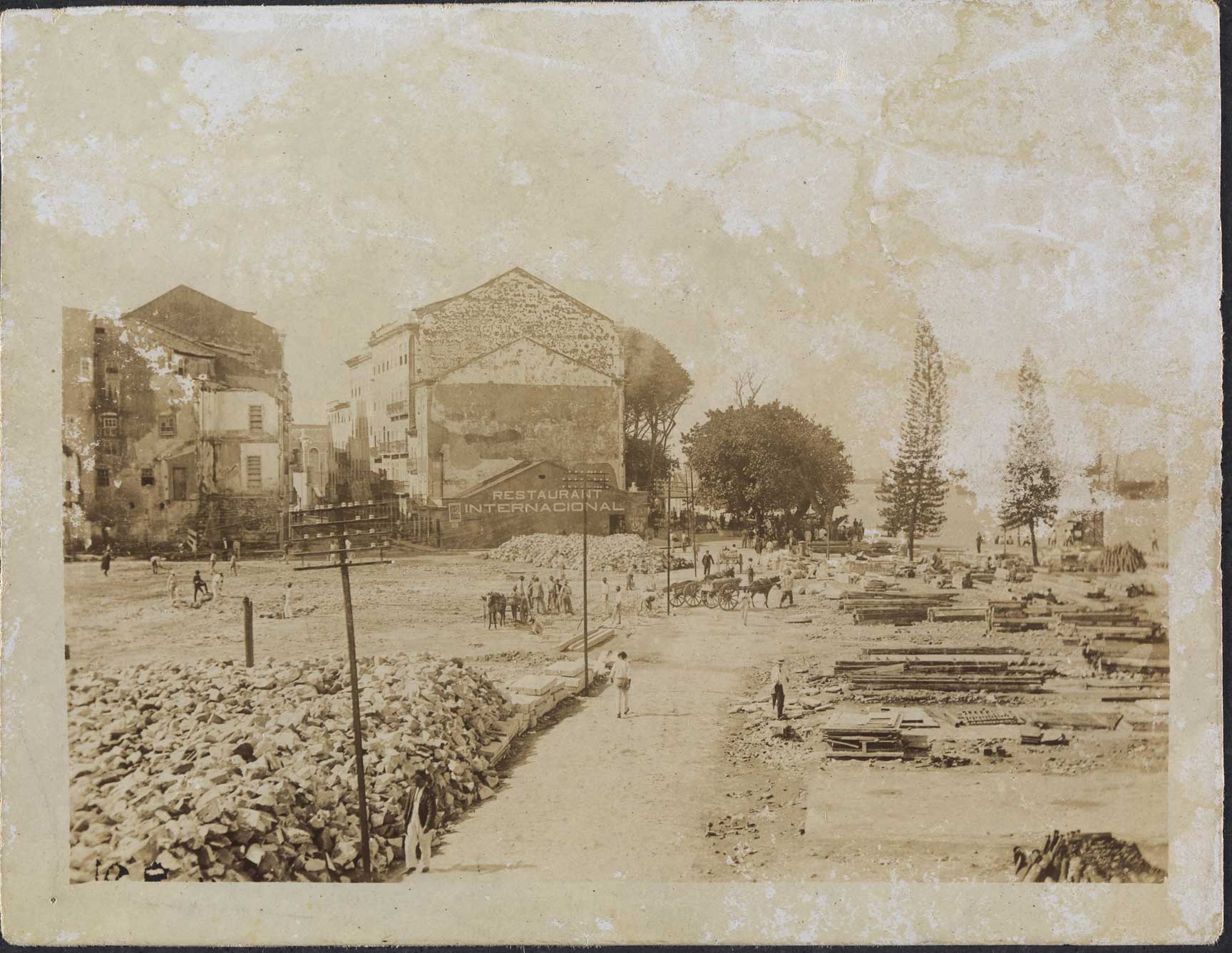
Featured image: G.S. Fellows, 1911-1912, “Cidade do Recife, por ocasião das demolições e transformações.” Source: Fundação Biblioteca Nacional, Brasil (Biblioteca Digital Luso-Brasileira; https://bdlb.bn.gov.br/acervo/handle/20.500.12156.3/438115).