Ankita Shrestha
In a recent article on the Nepali online news portal Online Khabar (2025), a former-Maoist-turned-Russian-mercenary was interviewed during his celebratory homecoming moment: his appointment as a section commander in the Russian army. Recruited to the frontlines of Russia’s Ukraine War that has entered its fourth year, the ex-Maoist combatant is portrayed both as a celebrated war hero and as a successful migrant worker. What the media fails to report, however, is that his journey to foreign employment is an upshot of a most precarious, post-conflict, political legacy orchestrated by the Nepali state and arbitrated by the United Nations Security Council. As the guns were laid down ending the Maoist People’s War in 2006, 19,602 Maoist insurgents underwent the post-conflict reintegration process mediated by the United Nations Mission in Nepal (UNMIN); among them 4,008 ex-combatants, including 2,973 “child soldiers”, were “disqualified” from civic life (United Nations Security Council 2010: 1-2). Following the Nepali government and the Communist Party of Nepal (Maoist)’s failures to negotiate the terms of reintegration of Maoist armed personnel with UNMIN, these disqualified ex-Maoist rebels rejected economic packages designed to reintegrate them into civil society and subsequently turned to foreign employment, mostly in conflict zones abroad. Forgotten since as revolutionaries of a decade long civil war that brought down more than two centuries of authoritarian monarchy and brought about federalism in the country, the ex-Maoist combatant—now a Russian army section commander and a migrant worker at once—quietly surfaces almost two decades later, quoted in the article as saying: “one does not get to live one’s own dream, but sometimes one gets to live another’s dream … once Nepal’s decade long Maoist war fighter, I am in Lenin’s country today fighting his war for Putin against Ukraine” (Online Khabar 2025, my translation). The war is clearly not over yet.
When the Maoist People’s War ended in 2006, “it was difficult”, my interlocutors claimed, “to tell who was a Maoist and who was not. Because we were all Maoists at some point”.[1] When the civil war began in 1996, the Maoists were distant figures for many, like myself, who came of age in Nepal’s capital, Kathmandu, where I encountered the war through a mediated sense of proximity via nightly news broadcasts. By the turn of the century, casualty counts had escalated into the thousands. In 2001, the Nepali state declared a state of emergency and issued the Terrorist and Disruptive Activities (Control and Punishment) Ordinance (TADO), identifying the Maoists as “terrorists” (Davis et al. 2012: 123) and establishing itself as a counterterrorist state in the context of the United States global “war on terror” (Dixit 2015). In 2006, I witnessed the historic yet rapid political incorporation of Maoist leadership into government (Rahman 2006; Sengupta 2006) and the signing of the Comprehensive Peace Accord (Al Jazeera 2006) from the vantage point of the capital—a moment that became the primer to my doctoral research on former Maoists’ civic participation and everyday forms of resistance in the new federal government (see Shrestha 2025). If, indeed, from the vantage point of the capital, the Maoists appeared as something that could be politically contained and categorized, it was only in my fieldwork encounters that the limits of an urban, mediated clarity became apparent, as the distinctions between Maoist “terrorist” and civic resistance were rejected through the “indistinction” my interlocutors forcefully articulated. In the many rural communities with civil war legacies where I have been field-embedded with ex-Maoists over the past decade, I was reminded time and again of what Nicola Perugini (2025) has called the “anti-colonial indistinction” we often draw (or perhaps one we would rather not draw) between resistance fighters and civilians—an indistinction that serves the colonial machinery to unapologetically annihilate both with full genocidal fervour, as is being done to Palestinians by the Israeli state. With an estimated 17,000 conflict-related deaths registered with Nepal’s Truth and Reconciliation Commission (The Kathmandu Post 2023), and approximately 1,300 individuals forcibly disappeared by both state and Maoist forces (Office of the High Commissioner for Human Rights 2012)—and actual figures of casualties and disappearances thought to be much higher due to underreporting and incomplete documentation—this indistinction is vitally being narrated after 20 years in communities across Nepal where many ex-Maoists who fought to dismantle oppressive state regimes at home have turned to foreign employment. Their testimonials point to the pernicious everyday politics of the post-civil war era that reduced their lives to wartime radicalism, violence, and criminality, that then qualified them for one thing only: fighting more wars.
Parallel to the Maoist grassroots resistance movement falling silent in 2006, conflict was not lacking elsewhere in the world, with the US at the forefront of waging “forever wars”, particularly in territories other than its own. The US “war on terror” alone saw military escalations of over USD 21 trillion just in the two decades after 2001, with a global footprint of military bases and deployments in 85 countries, almost half of the world, becoming a permanent budgetary and policy structure for the world’s most armed country (Glück 2024; Koshgarian et al. 2021). Since, the growth of defense and private military contractors, the Artificial Intelligence and autonomous weapons arms race bolstered by the “military-digital complex” integrating cyber and technology sectors with defense stratagem, and the hyper-normalization and abuse of security and surveillance forces in both domestic and foreign governance, prove that the US has decidedly “entered” what scholars call a “global war regime”: a machinery of governance embedding war’s logic into a permanent operational mode around which state power, capital accumulation, and technological innovation orbit (Hardt and Mezzadra 2024). This, scholars argue, is now a structural reality in which military, corporate, and state actors operate hand-in-hand. Security, surveillance, and militarization become inherent rather than exceptional components of governance. And this “war logic” extends into economic and social life, razing them as they would territories marked as “legitimate” nuclear battlegrounds. While scholars then argue that dismantling this “war regime” requires a strategy of “desertion”—a transnational, collective withdrawal from the social relations of the war regime through the cultivation of networked internationalist movements (see Flohr 2026)—I put forth that those of us in the global majority, the Black and Brown races, have yet to decide whether wars have ever been a “state of exception” if they have perpetually reorganized our lives such that some states are forever ready to wage wars at the expense of other states, and some individuals are considered forever disposable within these expenses (Chossudovsky 2010, 2015; Mbembe 2019). Because this “global era” of “war regimes” can only be announced—markedly by scholars now directly under such regimes “at war” in the West—upon the strength afforded by the silence of those equally oppressive regimes that have exported their workers, sustaining the life of war regimes when they were in suspension. Because wars have always needed their workers.
The evidence: the ready availability of these workers in Nepal coinciding with the genesis of global war regimes. As the US war on terror began in 2001, the Nepalese civil war too was escalating, and a mass exodus of Nepali migrant workers occurred to countries in the Middle East, including the Gulf Cooperation Council and Israel, where the US was fighting both direct and proxy wars. When civilian and rebel deaths reached their highest in the years leading up to 2006 in Nepal, and the Maoist war entered “ceasefire”, migrant workers, now including ex-Maoists, continued to leave the country mostly to the same destinations. While Nepal’s readiness to export labour particularly at the cost of migrants themselves has always been rife, this readiness after 2006 has particular ethical and political stakes. Aided by a systemic undermining of rebellion identity in migration policy, statistics, and scholarship, Nepal has since issued over four million labour permits, raised billions in remittances, and exported roughly 2,000 workers daily to foreign countries (International Organization for Migration 2023; Ministry of Labour, Employment and Security 2025), including those marked war zones, like Russia (Pathirana 2026). As Maoist political demands were galvanized into building a federal nation-state, grassroots class, caste, indigenous, and gender struggles—articulated for (rather than in critical view of) political participation and statecraft—systematically resurrected extant social hierarchies and inequalities. And as transnational measures of peace-building and reconstruction of the ailing Nepali society advanced, both insurgent and migrant identities were consistently made devoid of its political traces, a trend that today shapes how carceral topographies for migrants, refugees, and asylum seekers are managed. Maoist “insurgent-migrants” may thus appear as coincidental figures within today’s “global war regime”, but their emergence represents a transnationally coordinated mode of governance, involving both exporting and receiving states that manage their mobility by depoliticizing migrants. Indeed, wars never cease for these workers.
And therefore a distinction is vital here. Not for the purposes of separating the good war from the bad, the good migrant from the bad, or indeed the good insurgent from the bad, but to distinguish who is fighting whose wars? And why are some individuals made disposable over others to fight them? Nepal’s Maoist “insurgent-migrants” have an urgent answer. Politically disqualified at home, economically expelled abroad, and reincorporated into foreign war machines, they embody the ethical and political stakes of labour, livelihood, and life itself. To say that wars never cease for these workers is not only to note their continued exposure to violence elsewhere. It is to recognize that they carry insurgent histories into battlefields elsewhere; for migration is not a cessation of rebellion or autonomy but its continuation (Bhagat 2025). Here, I want to steer clear of any lament for the decline of a global “imperial hegemon”—the United States—a loss that is read as crisis within Euro-American scholarly discourse that interprets the afterlives of empire as rupture rather than continuity. Indeed, a loss that appears newly catastrophic to those who were long shielded from the everyday violences of imperial rule, and who must encounter its unraveling only when its effects reach their own doorstep (see Hardt and Mezzadra, 2024). For the global majority, the permanence of a “global war regime” sustained overtly by capitalism has been a long-standing structuring reality. Yet, in it, none of us are spectators. The difference is where we are positioned: some of us are made expendable at its frontiers; others live daily existence in the safety of our homes and workplaces. But within this lulling humdrum, the question is not whether we live in a global war regime. Rather, it is from what position within it we labour, or more precisely, whose wars we sign up to fight.
Ankita Shrestha is an independent scholar currently working on intersecting geographies of insurgency. She holds a PhD in Human Geography from the University of Oslo, where she completed her Marie Skłodowska-Curie Actions EU Horizon 2020 funded doctoral project, “The Myth of the Political”. Trained in literary, historical, and political theory and research methods, she works across anarchist and postdisciplinary thought.
Endnote
[1] This research is part of my independent project of the same title, currently in its early stages and developed outside institutional affiliations and funding structures. It builds on a decade of field-based research and sustained relationships with interlocutors across Nepal.
References
Al Jazeera. 2006. “Nepal Celebrates Peace Deal.” November 22. https://www.aljazeera.com/news/2006/11/22/nepal-celebrates-peace-deal.
Bhagat, A. 2025. “The Autonomy of Migration as Travelling Theory: Situated Principles from Nepal.” Environment and Planning D: Society and Space. https://doi.org/10.1177/02637758251365388.
Chossudovsky, M. 2010. “Food, Water and Fuel: The Crisis of Life Under Capitalism.” In Imperialism, Crisis and Class Struggle, edited by H. Veltmeyer, 203-217. Brill.
Chossudovsky, M. 2015. Globalization of War: America’s “Long War” Against Humanity. Global Research.
Davis, P. K., E. V. Larson, Z. Haldeman, M. Oguz, and Y. Rana. 2012. “Public Support for the Maoists in Nepal.” In Understanding and Influencing Public Support for Insurgency and Terrorism, 119-150. RAND National Defense Research Institute.
Dixit, P. 2015. “Securitization and Terroristization: Analyzing States’ Usage of the Rhetoric of Terrorism. In State Terror, State Violence: Global Perspectives, edited by B. Koch, 31-50. Springer.
Flohr, M. 2026. “Thinking With and Beyond the Global War Regime.” Portolan, February 28. https://portolan-journal.org/?post=thinking-with-and-beyond-the-global-war-regime.
Glück, Z. 2024. “Anthropology and the Security Encounter: Towards an Abolitionist Anthropology in the Age of Permanent War.” American Anthropologist 126, no. 3: 470-478. https://doi.org/10.1111/aman.13977.
Hardt, M., and S. Mezzadra. 2024. “A Global War Regime. Sidecar, May 9. https://newleftreview.org/sidecar/posts/a-global-war-regime.
International Organization for Migration. 2023. “Policy Brief—Migration and Skills Development.” https://nepal.iom.int/sites/g/files/tmzbdl1116/files/documents/National%20Level%20POLICY%20BRIEF%20-%20Jan23.pdf.
Koshgarian, L., A. Siddique, and L. Steichen. 2021. “State of Insecurity: The Cost of Militarization Since 9/11.” Institute for Policy Studies. https://media.nationalpriorities.org/uploads/publications/state_of_insecurity_report.pdf.
Mbembe, A. 2019. Necropolitics. Duke University Press.
Ministry of Labour, Employment and Security. 2025. “Nepal Labour Migration Report 2024.” Government of Nepal. https://moless.gov.np/content/13312/nepal-labor-migration-report–2024/.
Office of the High Commissioner for Human Rights. 2012. “Nepal Conflict Report.” United Nations. https://www.ohchr.org/sites/default/files/Documents/Countries/NP/OHCHR_Nepal_Conflict_Report2012.pdf.
Online Khabar. 2025. “Former Maoist Fighter Diamond Serving in the Russian Army Becomes Section Commander.” October 20. https://www.onlinekhabar.com/2025/10/1786710/former-maoist-fighter-diamond-serving-in-the-russian-army-becomes-section-commander.
Pathirana, S. 2026. “Revealed: At Least 455 Southasians Killed for Russia in Ukraine War, Ukraine Says.” Himal Southasian, March 5. https://www.himalmag.com/politics/russia-ukraine-war-casualties-southasia-srilanka.
Perugini, N. 2025. “Between Anti-Colonial Resistance and Colonial Genocide: Gaza at the Limits of International Law.” Journal of Imperial and Commonwealth History. https://doi.org/10.1080/03086534.2025.2578214.
Rahman, M. 2006. “After a Decade of Bloody War, Nepal’s Maoist Rebels Embrace Government.” The Guardian, June 16. https://www.theguardian.com/world/2006/jun/16/nepal.
Sengupta, S. 2006. “Maoist Rebels Agree to Join Nepal’s Government.” The New York Times, June 16. https://www.nytimes.com/2006/06/16/world/asia/16cnd-nepal.html.
Shrestha, A. 2025. “The Myth of the Political: An Anarchist Reading of the Narrative of Subjectivities of Resistance in Rural Nepal.” PhD thesis, University of Oslo. https://hdl.handle.net/11250/5368613.
The Kathmandu Post. 2023. “17 Years—and Counting.” November 21. https://kathmandupost.com/editorial/2023/11/21/17-years-and-counting.
United Nations Security Council (2010) “Report of the Secretary-General on Children and Armed Conflict in Nepal—S/2010/183.” https://docs.un.org/en/S/2010/183.
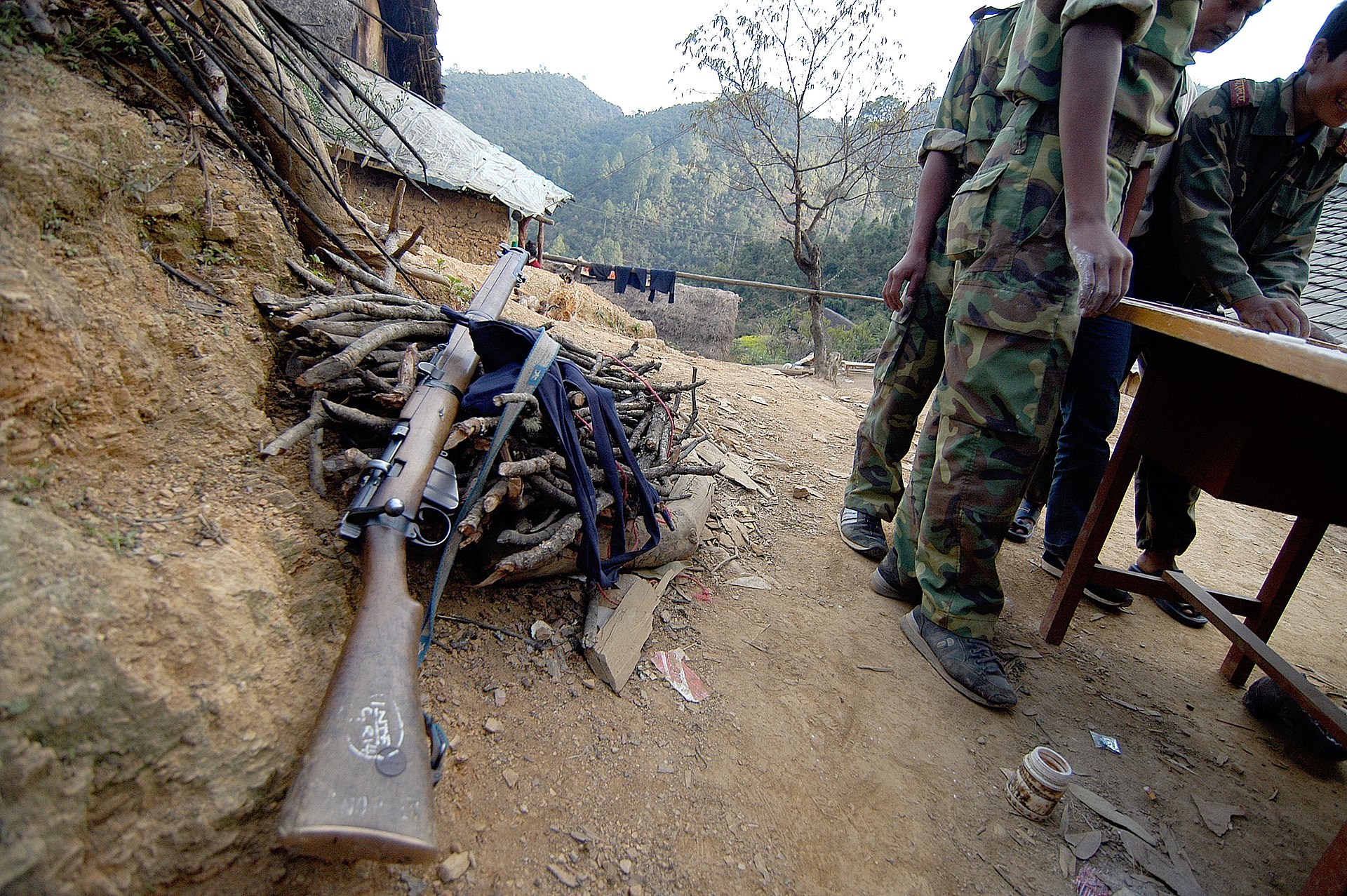
Featured image: A WWII British Lee Enfield .303″ rifle is left unattended near a group of Maoist rebels in the Rolpa district (Nepal), during a ceasefire. Photograph by Jonathan Alpeyrie via Wikimedia Commons. CC BY-SA 3.0.