James A. Fraser (Honorary Researcher, Lancaster Environment Centre)
As Colombia gears up for Presidential elections this May 2026, Iván Cepeda, the presidential candidate of the currently-in-power leftist coalition Pacto Histórico, has announced Aída Quilcué, a prominent Nasa Indigenous leader from Cauca, as his vice-presidential candidate. In the legislative elections of 8th March, Pacto Histórico emerged as the frontrunner, whilst in the presidential primaries of the same day, Paloma Valencia was also victorious, solidifying her as the candidate for the hard-right Centro Democrático.
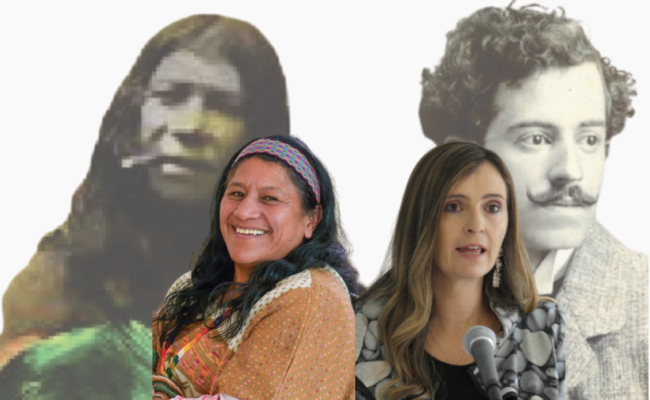
The event of Quilcué and Valencia each emerging as significant figures in the 2026 elections contains a coincidence of extraordinary world-historical import. The historic class struggle that these women represent, between Indigenous, Afro-descendant, and peasant peoples on the one hand, and mainly European-descended settler-colonial landholders on the other, was also exemplified by a clash between Aída Quilcué’s grandfather and Paloma Valencia’s great-grandfather a century ago.
If elected, Aída Quilcué will follow in the footsteps of Francia Márquez Mina, the current vice-president of Colombia, a Black woman from Cauca who rose to prominence defending her community against mining and displacement. The debate between Paloma Valencia and Francia Márquez during the 2022 electoral cycle was a watershed moment in Colombian political discourse. Márquez Mina contrasted Valencia’s descent from Euro-descendant slave owners with her own from enslaved Afro-Colombians. This was a profound public reckoning that directly linked the Valencia family’s contemporary political and economic capital to its historical roots in the slave-owning and land-monopolizing aristocracy, which Valencia attempted to defend with a class-, race- and gender-blind liberal discourse of advancement through individual merit and hard work.
Cauca, the Macizo, and Colombia’s Foundational Conflict over Land
Quilcué is also from Cauca, and specifically from the municipality of Páez in the Macizo Colombiano region, the birthplace of Colombia’s three Andean ranges and major rivers, Magdalena, Cauca, Patía, Caquetá and Putumayo; and location of Popayán, one of Colombia’s most important cities historically, with Bogotá, Cartagena and Santa Marta. In 18th and 19th century Cauca, an exploitative land tenure system intimately linked Indigenous resguardos (collective properties) to large haciendas. Germán Colmenares’ (1989) analysis revealed how the resguardo functioned as a deeply contradictory spatial institution; while it formally safeguarded Indigenous collective territories, it simultaneously confined communities to insufficient, marginal lands, effectively transforming them into demographic reservoirs that supplied a segregated, captive labour force bound by terraje (debt peonage) to the expanding haciendas of conservative elites, all the while Indigenous lands more attractive for plantations continued to be expropriated. By the dawn of the 20th century, Indigenous peoples faced severe territorial encroachment and landlessness.
Against this backdrop, the ancestors of Quilcué and Valencia, representing diametrically opposed visions of the land that are fundamentally similar to those held by these two women today, violently collided. Paloma Valencia’s great-grandfather, Guillermo Valencia (1873-1943), was Colombia’s minister of war in 1915, whilst his son, Paloma’s grandfather, Guillermo León Valencia (1909-1971), was president of the country from 1962 to 1966. Father and son were both slave owners whose political and economic power came from sugar plantations. For them, the enabling liberal institution of the (theoretically unlimited) accumulation of private properly needed to be defended through law and force.
Paloma’s great-grandfather confronted Manuel Quintín Lame Chantre (1880-1967), who is Aída Quilcué’s grandfather and one of Colombia’s most important historical figures, considered the founder of the country’s Indigenous movement. Quintín Lame was an Indigenous scholar and activist who educated himself in the laws of the republic and led a massive uprising against the colonial land tenure system. His foundational text, Los pensamientos del indio que se educó dentro de las selvas colombianas was written in 1939 but only published in 1971. Lame transformed oppressive legal frameworks into strategic tools for Indigenous resistance during the early 20th century. His approach was in effect an insurgent Indigenous legalism because he actively repurposed the state’s own assimilationist tools, subverting Law 89 of 1890 by making resguardos permanent rather than temporary as originally envisaged by the law. Karla Escobar’s fascinating work shows how the next generation of Indigenous activists took inspiration from Lame in using Law 89 to try to reclaim privatised land in Cauca during the 1970s (see also Espinosa Arango 2023).
Because of this threat to the landowning capitalist class, Lame was fiercely persecuted. Guillermo Valencia became one of his most prominent adversaries, utilizing his political influence to have Lame imprisoned, tortured and silenced. As Colombian sociologist Orlando Fals Borda (1975) claimed, this can be read as a key event restaging Colombia’s foundational conflict: the struggle over who owns the earth and how it is managed.
More than a century later, Cauca and the Macizo return to the national theatre, this time through the rise to prominence of the descendants of Guillermo Valencia and Quintín Lame. The modern Senate, and now the presidential race, is the battleground for these two competing visions of Colombia’s future reflecting this foundational conflict.
Senator Paloma Valencia carries the legacy of her great-grandfather and grandfather into the 21st century. She represents a political vision that prioritizes “security” for the wealthy provided by militarized state authority and the protection of private property in a country which has one of the most unequal land distributions in the world (10% of people own over 83% of land [IGAC 2024]). For the capitalist class that Valencia represents, land is an economic asset that must be protected from illegal occupations. She opposes autonomous Indigenous, Afro-Colombian and peasant governance, which she and her political allies tend to view as a threat to a unified national state.
Senator Aída Quilcué, on the other hand, steps into the vice-presidential ticket carrying forth the legacy of Quintín Lame. Having survived assassination attempts and the murder of her husband by the Colombian army during the armed conflict, like Márquez Mina she represents the need for restorative justice: the demand that the state recognize and repair five centuries of marginalization and violence against subaltern peoples in Colombia.
Aída Quilcué Transforming Quintín Lame’s Project for the 21st Century
Although separated by a century, the political projects of Manuel Quintín Lame Chantre in 1915 and his granddaughter Aída Quilcué in 2026 are fundamentally about the same thing: land. Quintín Lame spent decades navigating the Colombian legal system, using colonial titles to demand the restitution of the resguardos. His underlying rationale was never about bourgeois property rights. For Lame, land was an inalienable, living entity, the base for communal life that could not be partitioned or sold.
Quilcué elevates this concept into the contemporary conjuncture by transforming his defence of the resguardo into a broader demand for the sovereignty of “territories of life” (see Blaser et al. 2025). Quilcué advocates for the recognition of the territory itself as a living subject. As she stated during the first Encounter for the Truth, it is vital to acknowledge “the damages to Mother Earth” as central to the history of the conflict (see also CNMH-ONIC 2019). Quilcué has helped secure rulings where the Jurisdicción Especial para la Paz (JEP) formally accredits ancestral territories as victims with their own rights to reparation. The JEP recently recognized the Awá Indigenous people’s ancestral territory (Katsa Su) as a victim of conflict, acknowledging it as a living entity that suffers pain (Bries Silva 2025).
Ultimately, she transforms Quintín Lame’s defence of the resguardo into a broader demand for the sovereignty of territories of life that must be healed alongside their people. This builds on Planes de Vida (Life Plans), which emerged in the 1990s as a direct counter-narrative to Western, state-imposed development plans. While a traditional development plan might focus on resource extraction, infrastructure, and capital accumulation, a Plan de Vida is oriented around permanence and harmony. The Nasa and other subaltern peoples in Colombia now use these plans to structure their education, health, economy, and justice systems in ways that sustain the territory of life rather than exploit it.
Lame’s primary antagonist was the hacienda system which monopolized land and exploited Indigenous labour. Today, the geography of extraction in Cauca has evolved from the traditional hacienda into sprawling, agro-industrial sugarcane monocultures in the valleys. Quilcué’s platform presents a direct challenge to this modern iteration of the plantation economy. Her advocacy for food sovereignty, the recovery of ancestral seeds, and the expansion of Territorios Campesinos Agroalimentarios (TECAMs) and Indigenous resguardos serves as a spatial and economic barricade against agro-industry. Just as Lame sought to remove Indigenous bodies and land from the capitalist extraction chain, Quilcué’s environmental policies actively resist the homogenization of the landscape, championing diverse, life-sustaining (agro-)ecologies over export-oriented monocultures.
One of Lame’s most radical acts was his insistence on Indigenous self-governance. He drafted his own legal codes (Lame Chantre 1971)and asserted the right of Indigenous authorities to govern their own people, independent of the state’s domestic centre. Quilcué’s political career, rooted in the Regional Indigenous Council of Cauca (CRIC), reflects the institutional realization of this autonomy. Her reliance on the minga (collective action) institution and the Indigenous Guard exemplifies Lame’s vision of self-determination. The Guard acts as an unarmed mechanism of territorial control that protects communities from both armed actors and illegal resource extraction. It is a living assertion that the periphery possesses its own legitimate systems of governance and security, directly challenging the state’s historical monopoly on power.
Lame rejected the civilizing education of the urban elite, arguing that true knowledge was found “in the library of nature” (Lame Chantre 1971). He framed the Indigenous struggle as both economic and onto-epistemological one, a clash between the extractive logic of the colonizer and the reciprocal logic of the Indigenous inhabitant. Quilcué’s presence in the executive branch brings this epistemological rupture to the centre of state power. Her candidacy asserts that the solutions to Colombia’s crises, from climate change to systemic violence, cannot be solved by the same developmentalist logic that caused them.
Reversing Dependency?
To further understand the world-historical gravity of Quilcué’s insurgent candidacy and her political contrast with elite Paloma Valencia, dependency theory provides a useful framework. Latin American dependency theorists argue that since the colonial era, the global economy has been structured around a wealthy centre that extracts raw materials and cheap labour from a dependent periphery, actively under-developing the latter to enrich the former. Crucially, this centre-periphery dynamic does not just exist between regions (e.g. the Global North vs. Latin America); it replicates itself internally within nations. Read through Silvia Rivera Cusicanqui’s (1984) lens of internal colonialism, the confrontation between Quintín Lame and Guillermo Valencia exemplifies the deep structural violence of the nation-state, wherein the “lettered” creole hegemony attempts to silence living Indigenous political realities.
In the dependency framework, peripheral nations like Colombia require a domestic elite to facilitate the extraction of wealth for the global centre. Historically, the Cauca region, represented by Guillermo Valencia in the early 20th century and by his great-granddaughter Paloma Valencia today, has served this function. Yet as historical scholarship from Germán Colmenares (1989) suggests, the 20th century hacienda was not a monolithic engine of global export; instead, it navigated a shifting economic landscape where sugar production was increasingly tethered to the domestic markets of the Cauca Valley and Cali, while earlier reliance on aguardiente (a hard liquor made of sugar cane) monopolies highlights a fiscal history distinct from the intermittent pressures of the North American export market.
Irrespective of product or market however, the hacienda system was based on the terraje system, which functioned as a foundational mechanism of peripheral labour extraction by transforming ancestral residency into a form of labour rent. In this classic peripheral model, the goal is to produce commodities for a centre that cannot or will not pay the reproduction cost of labour. Terraje solves this by forcing the labourer to provide their own subsistence on a small plot while giving their surplus labour to the hacienda for free. This is pure rent seeking; rather than paying a wage, landlords collect “rent” in exchange for people’s right to exist on their own ancestral land. By coercing Indigenous communities into unpaid service in exchange for land access, the hacienda effectively externalized the costs of labour reproduction. This rent capture ensured a near-zero cost of production, facilitating a massive transfer of value from the rural periphery to domestic urban centres and global commodity chains.
Today, the political faction represented by Paloma Valencia continues to advocate for a vision of land use heavily focused on agro-industrial development, foreign investment, and institutional security, policies that maintain Colombia’s dependent integration into the global capitalist centre, often at the expense of more socially and environmentally sustainable agroecological alternatives. While the Valencia lineage represents the domestic centre managing this extraction, the political lineage of Manuel Quintín Lame Chantre and Aída Quilcué represents the existential resistance of the subaltern periphery, the imposition of this dependent economic model meant the violent reorganization of their economic geographies.
Lame’s early 20th century uprising was a direct rebellion against this system of dependency. Recognizing that land monopolies were actively impoverishing his people to feed the domestic centre, he urged Indigenous communities to rise against the “hoarders, multimillionaires, aristocrats, and oligarchs” who facilitated this internal colonialism. By demanding the restitution of ancestral territories as resguardos, Lame was attempting to remove Indigenous land and labour from the capitalist centre’s extraction chain. Directly challenging the elite’s accumulation of wealth, he declared “Cada indio de América debe ser dueño de un pedazo de tierra” (Lame Chantre 1971).
For Lame, recovering this territory was not about Indigenous people launching small enterprises in the capitalist export market. Instead, it was about defending the land as a caring mother that provides sustenance and ancestral knowledge, inherently rejecting the centre’s view of nature as a mere commodity to be exploited. Quilcué’s platform also challenges Cauca’s status as a dependent periphery by replacing the export-led agro-industrial model with the legal and material expansion of TECAMs and Indigenous resguardos. By de-linking land use from the requirements of the global sugar and commodity markets, her approach moves beyond President Gustavo Petro’s “productive modernization” toward a territorial sovereignty that prioritizes regional food stability over the funnelling of surplus to the national and global centres.
The world-historical significance of Aída Quilcué’s candidacy lies in the disruption of this centuries-old pattern. Historically, the executive branches of dependent states like Colombia have been exclusively controlled by the domestic centre, the urban elites and large landowners who manage the state’s unequal relationship with global capital. By proposing an Indigenous woman from the rural periphery for the vice-presidency, the Pacto Histórico is attempting to invert the power structure of the nation-state and break the historic cycle of dependency.
This election not only about who governs Colombia; it is a profound question of economic geography. Can the periphery, after centuries of providing the labour and land that built the centre, successfully claim the political apparatus to redefine the nation’s role in the global economy beyond industrial extractivism? This is already evident in Petro’s refusal to sign new oil and gas licences in the country (Malm and Guez 2025). The Cepeda-Quilcué ticket preserves the Pacto Histórico’s commitment to the politics of the periphery by evolving from Francia Márquez’s Afro-feminist activism to Aida Quilcué’s focus on Indigenous ancestral territoriality in the Southwestern Macizo region. However, it can also be seen to signal a strategic rupture by trading populist disruption for a seasoned legislative approach aimed at achieving institutional consensus through international law and formal Indigenous governance.
The ancestors Manuel Quintín Lame Chantre and Guillermo Valencia are watching, but so are other parts of the Global South.
Acknowledgements
Thanks to Victoria Frausin for help with and ideas for the article, and for creating the image accompanying it. Thanks also to Diana Ojeda for constructive criticism on a first draft which enabled me to write a much stronger piece, and Andrew Kent for his editorial work.
References
Blaser, M., S. Poirier, and P. Anthias. 2025. “Introduction: Territories of Life and the Struggles for Heterogenous Worlds.” In Territories of Life: Equivocations, Entanglements, and Endurances, edited by M. Blaser, S. Poirier, and P. Anthias, 1-34. University of Alberta Press.
Bries Silva, N. 2025. “Territory as Victim: Rethinking the Right to Reparation Through Awá Indigenous Territories.” AJIL Unbound 119: 140-144. https://doi.org/10.1017/aju.2025.10013.
CNMH-ONIC. 2019. Tiempos de vida y muerte: Memorias y luchas de los Pueblos Indígenas en Colombia. Centro Nacional de Memoria Histórica-Organización Nacional Indígena de Colombia. https://centrodememoriahistorica.gov.co/tiempos-de-vida-y-muerte-memorias-y-luchas-de-los-pueblos-indigenas-en-colombia/.
Colmenares, G. 1989. “Popayán: Continuidad y discontinuidad regionales en la época de la Independencia.” In América Latina en la época de Simón Bolívar, edited by R. Liehr, 157-181. Colloquium Verlag.
Espinosa Arango, M. L. 2023. “Democracy Against the Grain: Indigenous Politics in Colombia’s Southwest Andes.” Latin American and Caribbean Ethnic Studies 18, no. 1: 24-46. https://doi.org/10.1080/17442222.2022.2109381.
Fals Borda, O. 1975. Historia de la cuestión agraria en Colombia. Publicaciones de la Rosca.
IGAC. 2024. “Multipurpose Cadastre, basis for the SAT.” Instituto Geográfico Agustín Codazzi, Gobierno de Colombia. https://www.cepal.org/sites/default/files/static/files/gt_adm-tierra_colombia_dic2024_eng.pdf.
Lame Chantre, M. Q. 1971 [1939]. Los pensamientos del indio que se educó dentro de las selvas colombianas. Edited by G. Castillo. Rosca de Investigación y Acción Social / Editextos.
Malm, A., and M. Guez. 2025. “Colombia Against the Fossil Fuel Age.” Jacobin, August 21. https://jacobin.com/2025/08/colombia-fossil-fuels-climate-petro.
Rivera Cusicanqui, S. 1984. Oprimidos pero no vencidos: Luchas del campesinado aymara y qhechwa 1900-1980. HISBOL.