Erick Moreno Superlano, Centre on Migration, Policy and Society (COMPAS), University of Oxford
A former Green Beret turned content creator named Michael Yon has been offering guided tours of the Darién Gap, the roadless stretch of jungle between Colombia and Panama, a geography long regarded as uninhabitable, ungovernable, a “no-human’s-land” (Palma-Gutiérrez 2025). His clients have included Republican congressmen, podcast hosts, reporters from far-right outlets, and social media influencers, all of them drawn to the migrant camps on the Panamanian side of the gap where more than half a million people crossed on foot in 2023 alone, most of them Venezuelans fleeing the political and economic collapse of their country, a crisis that has displaced over eight million people and produced the largest exodus in the history of the Americas (Bensinger and Rios 2024). The visitors filmed exhausted families in overcrowded processing centres, asked politically loaded questions, and posted edited footage to digital platforms to warn their audiences back home of brown and poor people heading toward the US–Mexico border. Right-wing outlets like The Epoch Times and Infowars reproduced the content, and Donald Trump reposted some of it online during his 2024 presidential campaign. Among their followers and across much of the American right, they were received as patriots who had ventured into dangerous territory to expose US enemies’ “weaponization of migration” to destroy America (McCormick Sanchez 2024).
This intervention emerges from my doctoral research on how colonially produced geographical imaginations are mobilised through (social) media and political discourse to generate the moral ground on which the detention and deportation of racialised populations becomes politically profitable in the US. I conducted 18 months of fieldwork between 2024 and 2025 in New York and Florida, including digital ethnography across TikTok, Instagram, YouTube, and X, and interviews with fellow Venezuelans who crossed the Darién jungle.
The Darién Gap is the only break in the Pan-American Highway, a road that otherwise connects 14 countries from Alaska to the southern tip of Argentina. Conceived in the late 19th century as part of a hemispheric project to bind the Americas together, the highway reached Panama from the north and Colombia from the south, but the rainforest in between defeated every attempt of infrastructural development. The Darién has been ever since mapped in the collective imagination of the region as a geography closer to the forces of nature than to human order (Velásquez Runk 2015). (Post)colonial regimes in the Americas have projected civilisational hierarchies onto the landscape, marking tropical lowlands and jungles as the home of populations deemed inherently closer to the past than to modernity and whiteness, closer to primitive instincts than to reason and culture. Untamed geographies have been mapped onto the bodies of those typed as primitive, violent, and morally immature (Zeiderman 2025).
The digital content that right-wing figures produced in the Darién circulated on platforms like X and Real America’s Voice, where individual videos accumulated millions of views and were presented as evidence of an orchestrated invasion (Bensinger and Rios 2024). The content generated alarm because it activated emotions attached to an entrenched civilisational hierarchy between white America and the populations of Latin America, a hierarchy that has organised the racial imagination of the hemisphere for centuries (Seemann 2020). The edited images of brown and poor Venezuelans emerging from an ungovernable jungle reactivated a threat Americans had been conditioned to expect long before anyone crossed the border (Chavez 2025). The jungle had marked these bodies before they arrived, and the digital platforms on which their images circulated amplified the velocity and scale of the propagation and the alarm. By the summer of 2024, Donald Trump warned the Republican National Convention that Venezuela’s rogue government had purged its criminals and sent them to the United States (Valencia 2024).
In March 2025, the civilisational hierarchy that had coded Venezuelan migrants as criminal threats became immigration policy when the Trump administration invoked the Alien Enemies Act, a wartime statute to suspend due process and accelerate the deportation of Venezuelans to CECOT, a mega-prison in El Salvador built for gang members (NILC 2025). 238 Venezuelan men were designated as members of Tren de Aragua, a Venezuelan criminal organisation, and deported in defiance of a federal court order. Approximately three quarters had no criminal record in the United States, and many were identified as gang members based on tattoos that experts on the organisation say are not reliable indicators (Blitzer 2025). Individual acts of violence committed by Venezuelans were amplified by the administration and its communication ecosystem to create a narrative that Venezuelans embody the disorder of the ungovernable geography they came from. Despite courts issuing injunctions, a deeply entrenched civilisational hierarchy had been mobilised enough to manufacture the public demand for harsher bordering practices that these policies came to fulfil.
Centuries of colonial representation coded the Darién as a geography of violence and primitivism, and that codification transferred to the bodies filmed crossing it when content creators circulated their images to American audiences already conditioned to associate brown bodies with danger. The jungle “stuck” to the bodies of poor and racialised Venezuelan immigrants (Ahmed 2004). Sending them to a prison in El Salvador could register as the restoration of a civilisational order they broke when they crossed the southern border without legal documentation—or maybe before, when their images crossing the Darién reached the US digital space. Therefore their deportation is not seen by the administration as a violation, despite the process being violent and illegal. That violence did not produce the political pushback it would have produced had it been inflicted on white American bodies, coded by the same civilisational hierarchy as bearers of rights and fully human (Fassin 2007). Across the Americas, the colonial entanglement between race and space renders natural the suffering of people whose geography has stuck to their bodies and marked them as belonging to a world of violence (Sundstrom 2003). Their suffering feels to some degree as just a fact of life.
The governance of mobility between the Americas is entangled with entrenched geographies of race and civilisational hierarchies. Immigration policy in the United States is informed by a sociospatial mapping of the hemisphere in which certain populations are typed as ontologically violent and morally deviant (Molina 2014). That mapping naturalises an order in which the mobility of those coming from racialised geographies is perceived and felt as transgressive out-of-placeness, and in which coercive measures to contain them are perceived as the restoration of a natural order of things rather than as an act of state violence. In Trump’s America, such measures are seen as necessary and even patriotic. The campaign against Venezuelan migrants blurred the difference between people and their place of origin (Rosa and Díaz 2020), mapping the Darién jungle onto a criminal form of being that sticks to their racialised bodies and that no amount of geographical distance can redeem.
In January 2026, the United States launched a military operation to capture Nicolás Maduro, accused of leading a narco-terrorist organisation that had weaponised immigration against the United States. Trump announced that the United States would “run” Venezuela until a transition could take place. Whatever the atrocities of Maduro’s dictatorship, the political conditions under which a military capture of a head of state and the seizure of a country’s oil reserves could be received as law enforcement rather than as an act of imperial sovereignty did not emerge from nowhere. As Zeiderman (2025) demonstrates, mapping civilisational hierarchies onto geographies has long justified the extraction and management of resources that racialised populations are deemed incapable of managing.
References
Ahmed, S. 2004. The Cultural Politics of Emotion. Edinburgh University Press.
Bensinger, K., and F. Rios. 2024. “Chasing Clicks in the Jungle: Right-Wing Influencers Descend on the Darién Gap.” The New York Times, March 20. https://www.nytimes.com/2024/03/20/us/politics/migrants-darien-gap-biden-trump.html.
Blitzer, J. 2025. “Enemies of the State: How the Trump Administration Declared War on Venezuelan Migrants in the US.” The New Yorker, September 8. https://www.newyorker.com/magazine/2025/09/15/enemies-of-the-state.
Chavez, L. R. 2025. The Latino Threat: How Alarmist Rhetoric Misrepresents Immigrants, Citizens, and the Nation. 3rd ed. Stanford University Press.
Fassin, D. 2007. “Humanitarianism as a Politics of Life.” Public Culture 19, no. 3: 499–520. https://doi.org/10.1215/08992363-2007-007.
McCormick Sanchez, D. 2024. “‘Weaponized Migration’, a Coordinated Effort Playing Out Deep in the Panama Jungle.” The Epoch Times, March 4. https://www.theepochtimes.com/article/weaponized-migration-a-coordinated-plot-playing-out-deep-in-the-panama-jungle-5597754.
Molina, N. 2014. How Race Is Made in America: Immigration, Citizenship, and the Historical Power of Racial Scripts. University of California Press.
NILC. 2025. “Flights to Torture: Tracking the CECOT Disappearances.” National Immigration Law Center, August 19. https://www.nilc.org/resources/tracking-the-cecot-disappearances/.
Palma-Gutiérrez, M. 2025. “Migrant Struggles in the Darién Gap-Tapón: Rethinking a More-Than-Human Border.” Political Geography 123: 103426. https://doi.org/10.1016/j.polgeo.2025.103426.
Rosa, J., and V. Díaz. 2020. “Raciontologies: Rethinking Anthropological Accounts of Institutional Racism and Enactments of White Supremacy in the United States.” American Anthropologist 122, no. 1: 120–132. https://doi.org/10.1111/aman.13353.
Seemann, J. 2020. “Writing About ‘Our Good Neighbors South of the Rio Grande’: Moral Geographies of Latin America in the Early 1940s.” Geopolitics 25, no. 2: 510–537. https://doi.org/10.1080/14650045.2017.1418332.
Sundstrom, R. R. 2003. “Race and Place: Social Space in the Production of Human Kinds.” Philosophy & Geography 6, no. 1: 83–95. https://doi.org/10.1080/1090377032000063333.
Valencia, J. 2024. “Trump Says Venezuela Sends Criminals to the US: Here’s What to Know.” The New York Times, July 31. https://www.nytimes.com/2024/07/31/world/americas/trump-crime-venezuela-us.html.
Velásquez Runk, J. 2015. “Creating Wild Darién: Centuries of Darién’s Imaginative Geography and Its Lasting Effects.” Journal of Latin American Geography 14, no. 3: 127–156. https://doi.org/10.1353/lag.2015.0032.
Zeiderman, A. 2025. Artery: Racial Ecologies on Colombia’s Magdalena River. Duke University Press.
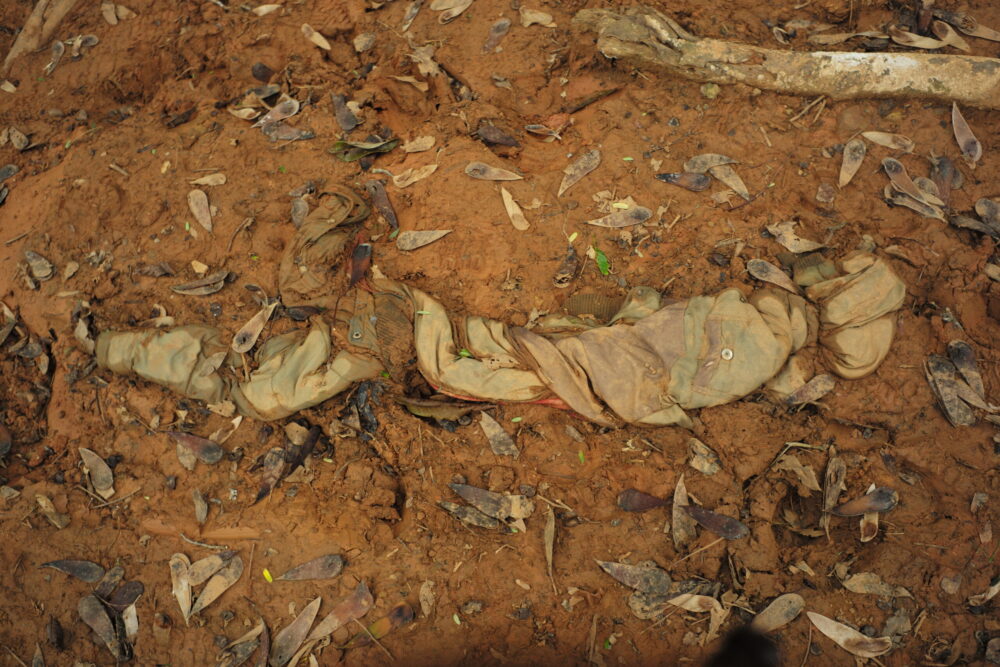
Featured image: “The Darien jungle sticks to migrants’ clothes. 2023.” Photograph by Ronald Pizzoferrato; reproduced with permission of the artist.