Anthony Zhu, Tsinghua University
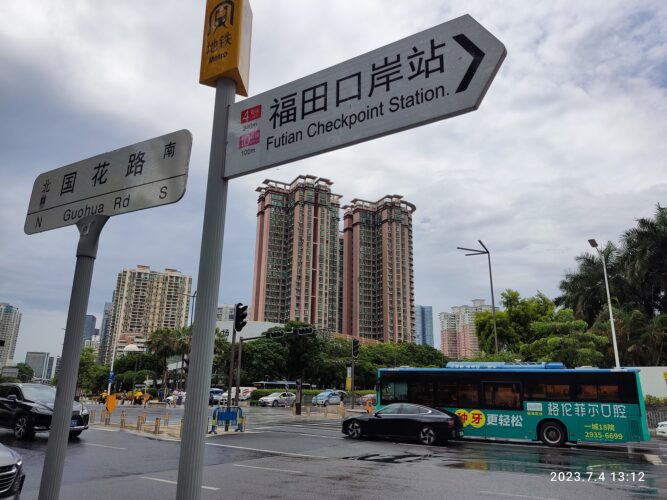
At Futian or Lo Wu in the early morning, they do not look like men going to work. They carry backpacks, sometimes a change of clothes, sometimes nothing at all. Their shoes are clean. Their phones are clean too—words like “payment”, “cement”, “tools”, and “settle up” have already been deleted from the chat history. If one looks only briefly, they are like the many others moving through the checkpoint each day: a little hurried, a little tired, trying not to draw attention to themselves.
Less than an hour later, some of them are in Sheung Shui, or in a village house near the border, changing into work clothes. The tools have come another way. A drill does not cross with the man who uses it. Heavy cutters, demolition tools, boxes of fittings—these are sent separately, carried by someone else, stored somewhere else, waiting on the Hong Kong side. The crossing is over, but the work of crossing is not. Only now does the worker become visible again as a worker.
This quiet movement sits awkwardly inside the familiar story of the Greater Bay Area. Officially, the region is described through bridges, rail, ports, research corridors, financial flows, and the circulation of talent. The keywords are always connection, integration, speed. But there is another kind of movement that does not fit the image so well. It is improvised, tiring, and made to stay half out of sight. It depends on people who cross not through a recognized channel, but through gaps, habits, and constant adjustment.
The contradiction is not difficult to name. Hong Kong has a serious shortage of labour in construction and renovation, with an ageing workforce and persistent recruitment difficulties (Legislative Council Secretariat 2024). On the mainland side, especially after the downturn in the property sector, there is no shortage of men who know how to tile a bathroom, rewire a flat, level a floor, or knock through a wall. The demand is there. The skill is there. What is missing is a formal route between them. This is not a new condition. As Attewell (2025) has shown, Hong Kong has long functioned as a node that draws labour across borders while keeping the terms of that labour deliberately unsettled; what has changed is the medium—tourist visas and WeChat groups rather than colonial labour registries—and the depth of deniability. There is no stable, ordinary, legal way for a mainland renovation worker to come to Hong Kong for a few days of residential work and then go home.
So the work continues, but in another form.
What matters here is not simply that these workers move, but how much of the missing connection is pushed onto the body. The body has to travel in a way that the job itself cannot. It must look harmless. It must pass as leisure. It must carry uncertainty that, elsewhere, would be absorbed by contracts, visas, insurance, employers, or recognizable intermediaries. Two places that are close in distance and far apart in legal form are held together, for a few hours at a time, by bodily effort.
This is where the usual language of infrastructure starts to look incomplete. Xiang and Lindquist (2014) taught us to see migration not as the simple movement of individuals, but as something organized through regulatory, logistical, and commercial arrangements. That insight matters here. But in the Shenzhen–Hong Kong corridor one also sees what happens when such arrangements are thin, partial, or deliberately withheld. The route exists for capital, for professionals, for tourists, for shoppers. It does not exist, at least not openly, for the short-term manual worker renovating private flats. Yet the labour is still there. The gap is not empty. It is filled by the body.
I call this embodied infrastructure. The term is only a way of pointing to something quite concrete. When institutional channels are absent, the body begins to do the work of connection. It buffers the break between two systems. It absorbs delay, suspicion, and risk. Simone’s (2004) phrase “people as infrastructure” is suggestive here, but only up to a point. What is at stake in the Shenzhen–Hong Kong corridor is not collective improvisation within a single city. It is a burden carried by individual bodies moving back and forth across a tightly regulated border. The border is what gives that burden its particular weight.
The strain shows first in time. A renovation worker in Hong Kong is not simply racing a clock. He is moving between two clocks that do not belong to the same world. There is, first, the clock of entry and stay: how often one crosses, how long one remains, how suspicious a pattern of movement begins to look. Then there is the clock of the worksite itself: the noise rules, the building management office, the security guard downstairs, the neighbour who sends a message to a residents’ WhatsApp group, the narrow stretch of hours during which a wall can be cut without drawing the wrong kind of attention. Griffiths and Repo (2020) have described how the discipline of Checkpoint 300 in Palestine reaches well beyond the crossing itself, bending the shape of entire days for the men and women who live in its orbit. Something not unlike that operates here, though through biometric gates and tourist visa limits rather than military barriers. Hong Kong’s Noise Control Ordinance (Cap. 400) sets one rhythm, but housing estates often make the workable window even smaller. A job that might be spread across several days in Shenzhen becomes, in Hong Kong, a compressed sequence of moves. Rest shortens. Meals are rushed. Loud work is squeezed into brief intervals. The body is what reconciles the two rhythms. Thompson (1967) wrote about the disciplining of labour through time. Here the discipline is doubled: not only the discipline of work, but the discipline of the border.
Then there is appearance. Crossing the border is not merely movement from one place to another. It is a repeated, careful performance. The worker arrives at the checkpoint stripped of the signs of labour. No tools. No obvious work clothes. No messages on the phone that can be read the wrong way. On the other side, the signs return. A different shirt. A stored backpack. A key to a room where tools are kept. Labour is taken apart before the checkpoint and put back together after it.
Workers describe this in practical terms as “person-cargo separation” (人货分离): tools moved through informal logistics, bodies told to dress like tourists, chat records cleaned before crossing. This is not a side issue. It is part of the work itself. In a sense, he crosses twice. First as a body that must look harmless; only later as a worker. Rijke and Minca (2019) have described checkpoints in Palestine as spatial political technologies—material arrangements that sort bodies through design. The Shenzhen crossing is sleeker, but the work it does is not so different. If the border is, as Mezzadra and Neilson (2013) argue, not simply a line of exclusion but a sorting device, then one of its smallest effects can be seen here: a body repeatedly edited into legibility.
Inside the apartment, another pressure appears. Renovation is noisy work. It announces itself through impact, dust, vibration, metal against concrete. But in Hong Kong’s tightly managed residential blocks, workers try to keep that noise below a threshold of notice. A guard may come up. A neighbour may complain. A message may be sent downstairs. Workers talk about learning to do the job “lightly”. Do not hit too hard. Drill in short bursts. Save the louder work for a moment when it can pass. One worker said it felt like “doing construction like a thief”.
The phrase does not need much gloss. It captures the way the body is asked to work against its own usual form. A body trained for force has to learn restraint. A job that normally leaves an acoustic trace has to become nearly silent. The worker does not only give strength and skill; he must also regulate breath, gesture, tempo, and sound.
Digital mediation makes the arrangement at once easier and harsher. Recruitment happens through WeChat groups, Xiaohongshu posts, Taobao storefronts, and small intermediaries who are often little more than a social media account with traffic. Control does not disappear; it changes form. Workers are matched remotely, supervised remotely, evaluated remotely. Site progress is photographed and sent through group chats. Clients inspect through their phones. But when something goes wrong—injury, non-payment, detention—the intermediary can vanish, while the worker remains exposed. The same digital chain that makes the job possible also helps erase who is responsible for it (cf. Chen 2022).
It would be easy to celebrate all this as resilience. Workers know routes, rhythms, loopholes, storage points, signs of trouble. They know how to move in ways that make the system usable. But that language gives too much away. What is being adapted to here is a structure that needs labour without wanting to recognize it.
This is why “differential inclusion” still helps name what is going on (De Genova 2002; Mezzadra and Neilson 2013). These workers are not fully excluded from Hong Kong. If they were, the work would stop. Nor are they included in any secure sense. They are brought in as labour power while being kept at a distance from the rights, protections, and recognitions that might stabilize that labour. Their illegality is not outside the system. It is one of the ways the system keeps labour cheap, flexible, and deniable.
From the ground, then, the Greater Bay Area looks less seamless than selective. Official integration is narrated through hard infrastructure and elite circulation. It tells a story about what moves smoothly. But if one begins from labour rather than capital, a different map appears. Some forms of movement are enabled and celebrated. Others are tolerated only so long as they remain informal, quiet, and cheap.
That is perhaps the more difficult infrastructure of the bay area to reckon with. Some infrastructures are made of steel and policy. Others wake before dawn, carry no tools, and try not to look like they are going to work.
Anthony Zhu Tuo is a Ph.D. candidate in Science, Technology, and Society (STS) at Tsinghua University. His research examines institutional differences in the Greater Bay Area and their impacts on scientific collaboration and mobility. This essay extends that inquiry to the terrain of labour, borders, and urban informality, drawing on digital fieldwork conducted in 2025 across platform ecologies used by cross-border renovation intermediaries—primarily Xiaohongshu, Taobao, and WeChat—as well as interviews and observation in border-adjacent neighbourhoods in Shenzhen and Hong Kong’s New Territories. A longer version of the argument is in preparation.
References
Attewell, W. 2025. “East by Southeast: Hong Kong in the Decolonising Pacific.” Antipode 57, no. 5: 1825–1845. https://doi.org/10.1111/anti.70043.
Chen, L. 2022. “Labor Order Under Digital Control: Research on Labor Control of Take-Out Platform Riders.” Journal of Chinese Sociology 9: 17. https://doi.org/10.1186/s40711-022-00171-4.
De Genova, N. 2002. “Migrant ‘Illegality’ and Deportability in Everyday Life.” Annual Review of Anthropology 31: 419–447. https://doi.org/10.1146/annurev.anthro.31.040402.085432.
Griffiths, M., and J. Repo. 2020. “Women’s Lives Beyond the Checkpoint in Palestine.” Antipode 52, no. 4: 1104–1121. https://doi.org/10.1111/anti.12627.
Legislative Council Secretariat. 2024. “Shortage of Construction Workforce in Hong Kong.” Statistical Highlights ISSH34/2024. https://app7.legco.gov.hk/rpdb/en/uploads/2024/ISSH/ISSH34_2024_20241212_en.pdf.
Mezzadra, S., and B. Neilson. 2013. Border as Method, or, the Multiplication of Labor. Duke University Press.
Rijke, A., and C. Minca. 2019. “Inside Checkpoint 300: Checkpoint Regimes as Spatial Political Technologies in the Occupied Palestinian Territories.” Antipode 51, no. 3: 968–988. https://doi.org/10.1111/anti.12526.
Simone, A. 2004. “People as Infrastructure: Intersecting Fragments in Johannesburg.” Public Culture 16, no. 3: 407–429. https://doi.org/10.1215/08992363-16-3-407.
Thompson, E. P. 1967. “Time, Work-Discipline, and Industrial Capitalism.” Past & Present 38: 56–97. https://doi.org/10.1093/past/38.1.56.
Xiang, B., and J. Lindquist. 2014. “Migration Infrastructure.” International Migration Review 48, no. S1: 122–148. https://doi.org/10.1111/imre.12141.
Featured image: “SZ Shenzhen Futian Fuqiang Road Guohua Road Futian Checkpoint Port Metro Station sign July 2023” by WulsimBorfuooS via Wikimedia Commons CC BY-SA 4.0