Antipode‘s 9th Institute for the Geographies of Justice (IGJ), “Radical Geographies of Social Reproduction”, took place in Minneapolis, Minnesota, traditional homelands of the Dakota people, June 3rd to 7th, 2024.
Social reproduction is squarely on the scholarly agenda in the wake of multiple and intersecting social, economic and ecological crises. Struggles over social reproduction reveal tensions between status quo survival and radical transformation, between extending racialized, gendered hierarchies of capitalist value and disrupting them to manifest a world otherwise. Radical geography has long centered space and place at the heart of these tensions. As a deeply contingent geographical process, social reproduction materializes in neglected, disinvested and toxic landscapes; in household strategies to navigate financialization and mounting debt; and in ever expanding technologies to appropriate the unpaid labor of life itself.
Antipode’s 9th Institute for the Geographies of Justice (IGJ) provided an opportunity to engage theoretical, methodological, and practical issues related to research and scholar-activism on social reproduction. This workshop was specifically designed to meet the needs of early career researchers over the course of five full days. The program included plenaries and fora for debate as well as practical sessions such as strategies of writing and representation, publishing and engaging with diverse audiences within and outside academia, embracing ethical translations and engagements with interpretive communities outside the academy, and more.
Activities over the course of the five-day institute included panels, training and skills modules, and a field trip. New to this year’s IGJ, the 23 participants had the opportunity to contribute a paper, chapter, or a part thereof, to be workshopped by fellow participants, plenary speakers, and local faculty.
The institute was co-hosted by the University of Minnesota’s Department of Geography, Environment and Society and made the most of its location in Minneapolis by featuring participation from a range of UMN faculty as well as field trips to the places where UMN faculty have ongoing collaborations with communities.
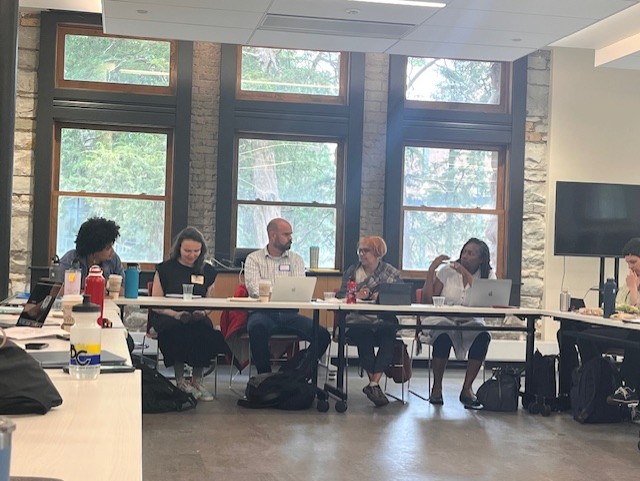
Invited faculty fellows at the 2024 IGJ were:
Kiran Asher (University of Massachusetts, Amherst)
Beverley Mullings (University of Toronto)
Diana Ojeda (Indiana University)
Bradley Wilson (West Virginia University)
Faculty contributors from the University of Minnesota included Vinay Gidwani, Madelaine C. Cahuas, Adam Bledsoe, Bruce Braun, Arun Saldanha and Richa Nagar.
The organizers of the meeting were: