Diego Melo (University of Colorado Boulder)
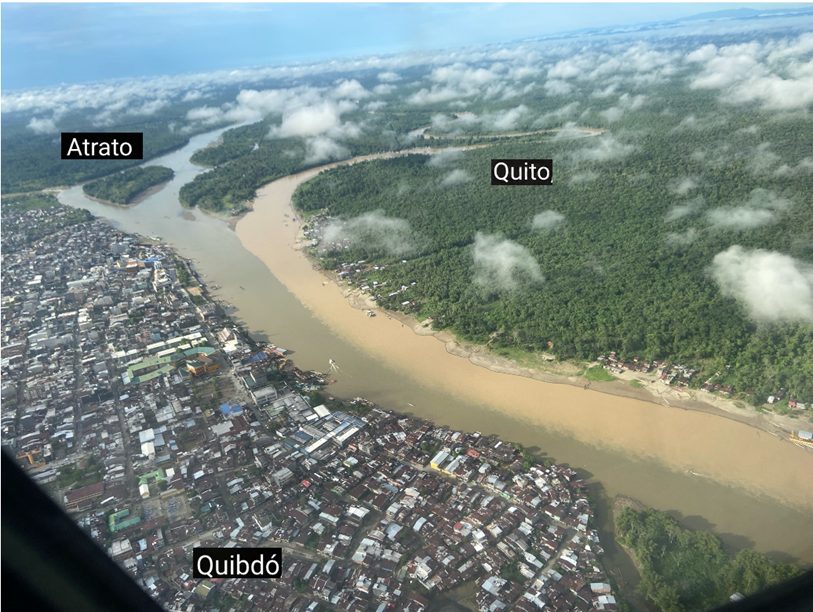
Since meeting him in 2015, my friend Bernardino Mosquera has inspired me. Being my dad’s age, Bernardino has taught me, and thousands of other people working for the Colombian state, NGOs, and private capital, about the turbulent socio-material forces that have shaped the Atrato River in the last 60 years (Mosquera 2019). Bernardino navigates the Quito River weekly, traveling between his hometown, Paimadó, and Quibdó, the capital of Chocó, through a route that ends where highly sedimented waters pour onto the Atrato River. The striking image conceals a multiplicity of stories, practices, and forms of violence enacted on the periphery of the periphery of global racial capitalism. Bernardino has helped me decode some of these assemblages and introduced me to many beloved comrades with many other stories to share. This photo essay reviews our 2023 “Right to the Discipline Grant”, which allowed us (Bernardino and I, alongside Juan Diego Espinosa and Diego Andrés Núñez) to produce a new format of earth-voicing: an upstream immersion, a polyphony of feminist, campesina, and Black-male-miner geographies, which now make a digital archive of the Atrato “river-as-subject” and amplifies the voices, priorities, and narratives of grassroots organizers living along this river.
The Background
In the article “A Postcolonial Marxist Critique of the River-as-Subject: Situating the Atrato River in Its Development Aporias” (Melo-Ascencio 2024), I discuss how the Constitutional Court Ruling that declared the Atrato “a subject with rights” (T-622 of 2016) is a type of development discourse. As a living text organizing actors’ priorities, practices, and responsibilities, the ruling articulates a racialized history of nation-building with the capitalist world system today. My central argument is that emerging calls to theorize a river-as-subject ontology must grapple with the fraught politics of nature’s rights and how recognizing legal personhood for rivers performs conceptual work for capital. In the piece, my main emphasis is the expanding alluvial gold mining frontier that unfolds under the defense forces’ mandate to “eradicate illegal mining” and through the inclusionary exclusion of the community-based plaintiffs that sued the government in the first place.
Juan Diego Espinosa and Diego Andrés Núñez, alongside the environmental justice NGO Siembra, produced a 12-minute clip explaining this ruling and its unsatisfactory implementation (Cuerpo Colegiado et al. 2023). However, my work goes beyond the shortcomings of the court ruling and refuses its terms of intelligibility. Instead, I examine the ongoing processes of dispossession behind (and all around) the river’s legal personhood. In line with this work, I invited Bernardino and Juan Diego to produce a different type of discourse.
In 2023, we presented a proposal to the Antipode Foundation with three objectives in mind. First, we proposed a film to transgress mainstream narratives about ethno-territorial rights and the rights of nature that sanitize the environmental racism running through extractive activities along the Atrato. Second, we offered to explain that mining-induced river degradation is an operation of racial capitalism in which white mestizos prey on Black communities’ territorial knowledge about the location of alluvial gold deposits (through investments in land, heavy machinery, wages, and gold dividends) to dispossess Afro-descendants of their gold and family croplands. Third, we drew a parallel with what Ruth Wilson Gilmore (2017) calls a carceral regime, wherein actors deploying heavy machinery extract not just gold, but the key resources of Chocoan Blackness: ancestral knowledge, labor-power, and the unpaid reproductive labor of Black women and men, which co-constitute value—the socially necessarily labor time exploited at mining enclaves.
The idea of producing a documentary was soon discarded. The conflict between the Colombian military, the Gulf Clan (a drug-trafficking neo-paramilitary group), and the National Liberation Army (the largest remaining guerrilla group in Colombia) intensified in 2023 and 2024. The confrontation posed risks to us and anyone in riverine communities who was seen with paisas (light-skinned visitors from Colombia’s Andean region) with large cameras and microphones. Given the specificity of our idea and the multiple objectives, an alternative was to produce a video podcast recorded at key places and focused on curated yet flexible conversations.
The result was Deep Bonds (or Lazos Profundos in Spanish), a “territorial video podcast” that complicates existing narratives about community resistance to mining extractivism, beginning in the Chocó Pacific lowlands in northwestern Colombia. It amplifies the voices of those who struggle to defend their livelihoods and territories from mechanized gold and copper mining but whose work (and words) are always subsumed under broader development agendas. The participants were organizers and community leaders working to implement the Atrato Court Ruling. They guided us into the struggles, unresolved tensions, achievements, and pending conversations amid the push to “protect, conserve, maintain, and restore” the Atrato River. Season 1, “Across the Atrato River Sources”, is made of four episodes that present subtle tensions, contradictions, and paradoxical connections based on the experiences, memories, hopes, dreams, and aspirations of its participants. It is a polyphony of critical discourse on the “river-as-subject”. Below is the backstage story and the synopsis for each episode.
Episode 1: The River is in Women’s Hearts
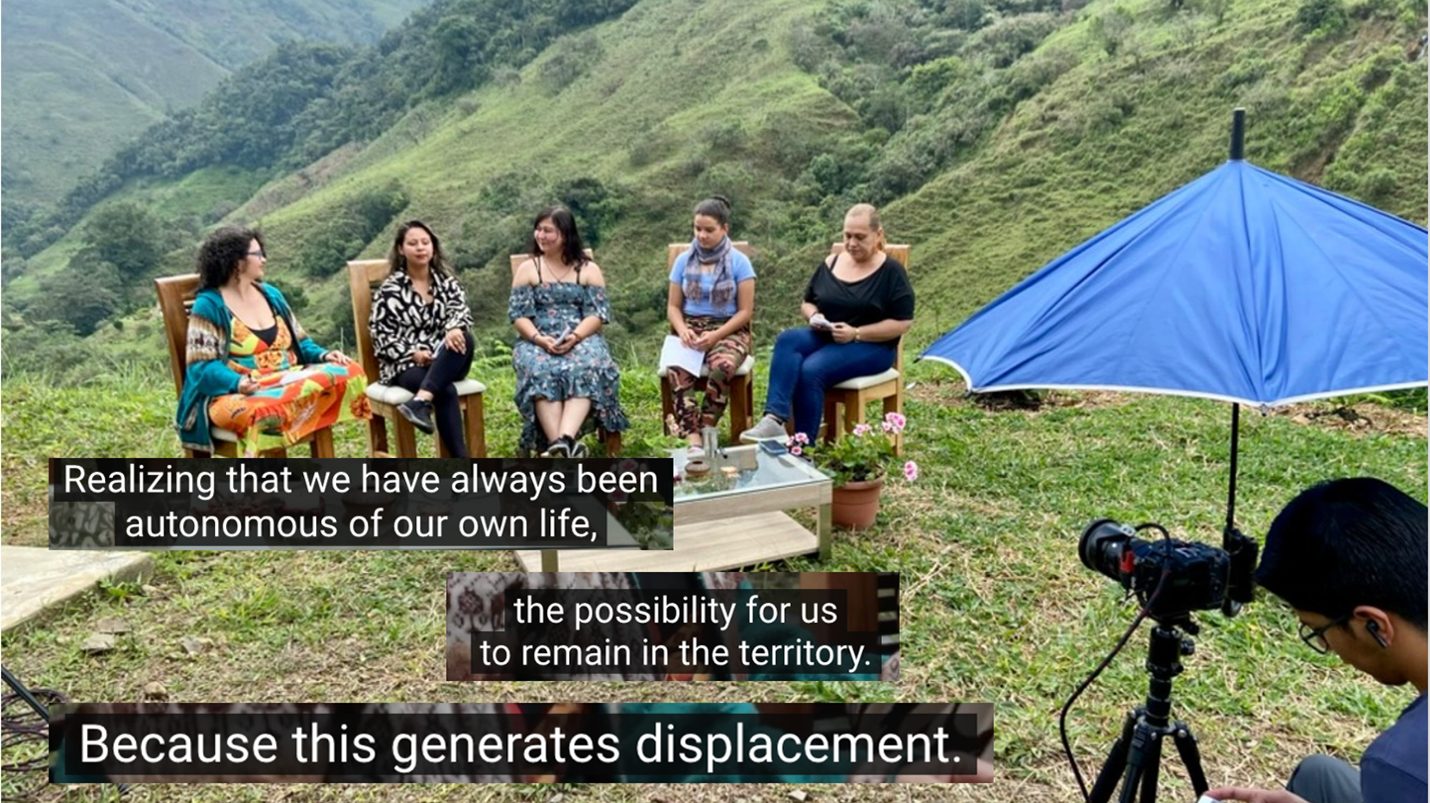
We began at the Atrato River’s source, in the municipality of El Carmen de Atrato, where the western Andes mountain range transforms into the Pacific lowlands. Tuned to ongoing complaints that the most outspoken anti-copper mining organizers in the town of El Carmen were authoritative men who did not embody a praxis of care, we decidedly embraced a feminist methodology. We centered the voices of peasant-farmer women and partnered with Andrea Ferro, an experienced organizer from a grassroots organization working in solidarity with peasant-farmer women (campesina) who oppose small hydroelectric dams in Western Antioquia (see Corporación Jurídica Libertad 2021). Andrea’s constant reminder for us was to keep life in the center.
From her sustained engagement with communities harmed by mass killings and forced disappearances tied to the Colombian armed conflict, Andrea helped us lead a two-day body-territory mapping workshop. We worked with women from the Peasant-Farmer Platform of El Carmen de Atrato (La Plataforma del Campesinado) prior to recording the first two episodes. We followed the conceptual framing of Lorena Cabnal (2013, 2014), whose notion of territorio-cuerpo-tierra emerged as she and other Xinka women demanded that violence against women be part of the struggle against mining concessions in Xalapán, Guatemala. We also followed the Ecuadorian Collective Critical Perspectives on Territory from Feminism (Colectivo Miradas Críticas del Territorio desde el Feminismo 2017), which guided our activities to identify and resist violations against women’s body-territories related to copper mining and extractivism more generally.

If our project was about Black communities harmed by riverine destruction in the tropical rainforest, why did we begin with the white mestiza peasant farmers from the mountains? Because the villages surrounding the town of El Carmen, where these peasant-farmer women live, are close to the source of the Atrato River and the only copper mine in Colombia thus far. Known as The Oak Mine (operated by Minera El Roble or MINER S.A.), the mine is one of several projects financed by the Atico Mining Corporation (2025), a transnational company registered on the Vancouver Stock Exchange. Since 2014, MINER has extracted gold and copper from El Carmen using water, energy, and labor-power while refusing to pay royalties for copper extraction (for a detailed discussion, see Siembra 2024). Only this March, the mining companies lost a legal case and are now obliged to pay these royalties to Colombia’s National Mining Agency (Montes 2025). Yet, the news coincided with that same agency’s announcement that it would sign a new mining concession to expand copper extraction at El Carmen de Atrato for the next 30 years (Agencia Nacional de Minería 2025).
In that context, Episode 1 showcases campesina organizers who fear their livelihoods will be reconfigured as the Colombian state enables copper mining to obtain revenues and advance the so-called just energy transition. The participants focused on the mine’s differential effects on women’s livelihoods, especially the gravitational pull of mining extractivism: the pressure against peasant farmers’ popular economies as people, near and far, become miners and contractors. This process slowly drains the countryside from its people, depletes water from underground reservoirs, and disincentivizes peasant farmers’ capacity to produce their own food. The five participants describe their organizing efforts and their hope that invigorating small-scale food production can be defended by reinforcing a campesino identity in children and youth. For the campesinas, practicing love for the land, the river, the food, and the animals is an alternative to becoming wage-based miners.
“The River is in Women’s Hearts” reminds us all that the water-intensive production of copper concentrate, tailings, and the toxicity derived unavoidably pass through the displacement and re-configuration of campesina livelihoods. And that heart vulnerable to harm and displacement is currently organizing to promote an alternative path where autonomous livelihoods resist the expansion of a sacrifice zone for the energy transition.
Episode 2: With Our Navels Planted along the Atrato
The second episode addresses the conflicts that have emerged along the road connecting two main cities, Quibdó and Medellín, as the Atrato River flows down the mountain into the jungle. The conversation focused on the long history of armed violence in the region, which includes massacres, selective killings, and forced displacement, as paramilitary death squads (powered by drug-trafficking monies) chased insurgent guerrillas throughout mountainous areas far away from major cities.
Through the concrete, situated, and affective memories of Black, Indigenous, mestiza, and white women living along the bridle road, or La Trocha (now a concrete highway), the participants explain that thriving businesses and relations of solidarity were shattered through fear and assassinations. Starting in late 1996, armed struggles wounded the hermandad, or the affinity among siblings who traded goods and shared spaces of recreation. Ever since Afrodescendants have struggled to return to places where Indigenous peoples fleeing violence were collectively titled the same land, and the land of whites and mestizos. In parallel, residents have started celebrating destructive deals with heavy machinery operators, thereby expanding the gold mining frontier in areas where the activity was unprecedented.
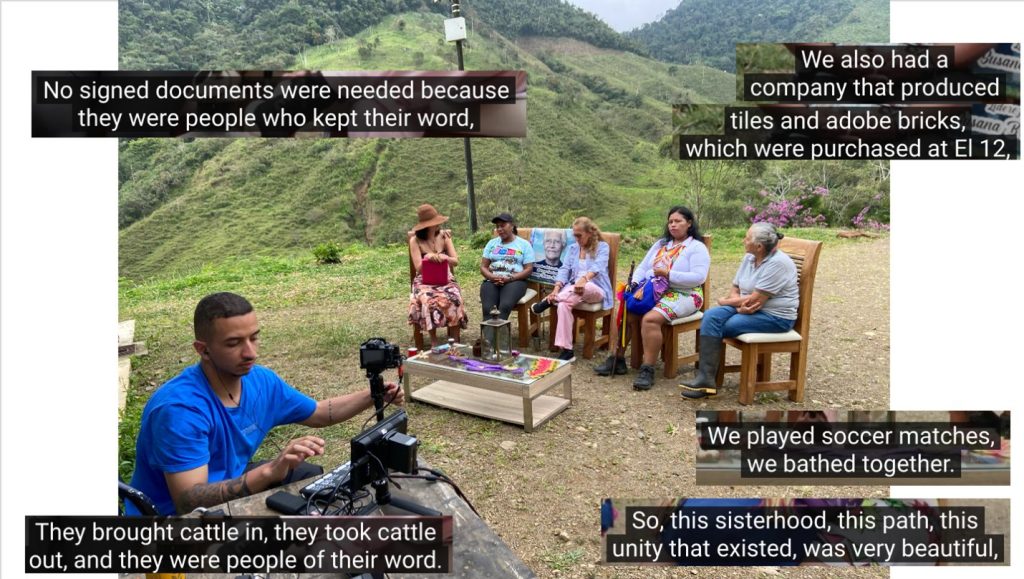
Analyzing the “before” and “after” 1996 as a wound, Andrea Ferro, the facilitator, framed the narratives as a way to “encarnar la resistencia” (enflesh the resistance). The expression adds nuance to the English notion of embodiment by highlighting the pain-in-the-flesh, or the corporeal ways that armed violence, displacement, and mining extractivism constitute the body-territory. Moreover, enfleshed resistance in this light means mobilizing memories and critical insights to harness the body-territory’s capacity for combat: caring, defending, healing, and strengthening our collectivities to overcome damaging, open, and bleeding wounds (Gago 2020: 99).
The tension in the episode is never resolved because each leader speaks on behalf of a distinct ethnic group with overlapping territorial claims. However, the women leaders collectively realize that traditional cartographic solutions to resolve land-based disputes, like the creation of Indigenous resguardos and Black community councils, do not prevent the encroachment of destructive mechanized mining throughout wounded communities. Instead, state institutions often conduct “acción con daño” (action with damage) because collective legal personhood is sanctioned without a broader awareness of the causes and consequences of dispossession.
Episode 3: The Pichindé’s Roots
The third episode focuses on Bernardino’s reforestation project, located along the Quito River across from Paimadó. Frustrated with the government agencies that inadequately used reforestation funding from the Atrato Court Ruling to plant achiote (annatto) seedlings without much thought or care, Bernardino endeavored to show that a community-based maintenance strategy could yield better results. He convinced the Colombian Ministry of Environment to finance an experiment over eight hectares of land to conduct reforestation activities more intentionally. Alongside the University of Córdoba and the World Wildlife Fund, Bernardino hired some of his Afro-Chocoan women neighbors and planted seedlings of endemic species in one of his extended family land plots, now an infertile sandbank left behind by dredgers and excavators.
Bernardino’s work is admirable, and our podcast conversation is honest and insightful. However, it should be interpreted as a sympathetic critique of those who believe that reforestation activities can “protect and restore” the Atrato River. In the episode, we explain that mechanized gold mining ruined families’ croplands to yield gold dividends. Women from Paimadó were permanently affected since many of them used to make an income panning for gold along meanders that no longer exist. Although the project is exciting given its willingness to pay Afro-Chocoan women in riverine communities to conduct reforestation (in collaboration with river stewards, academics, and conservation practitioners), there is a perverse logic backstage. Bernardino explains that reforestation cannot redress the long-term process of sacrificing lands to produce cheap gold, unless there is a systemic incentive for Black riverine community members to grow food and keep their inherited croplands (see Patel and Moore [2017] for the long history of cheap gold/money, and Melo-Ascencio [forthcoming] for how it unfolds along the Quito River).
The positive tone we engage in the podcast means we are both sympathetic and critical of restoration (one of the river’s rights) and its fraught attempt to address ruination through reforestation. Moreover, this “right of the river” might be yet another way the “river-as-subject” performs conceptual work for capital. Reforestation projects do not offer a sustained source of income to dethrone mechanized mining activities within Black collective territories. Instead, powerful conservation NGOs and the Ministry of Environment use the reforestation agenda as a proxy to promote green entrepreneurial subjects, which conspicuously aligns with the larger quest to promote carbon credits over the Chocó rainforest. However, rather than prove this loose intuition, our episode highlights the arduous organizing labor of Bernardino and Marcela, who work with what they get. Ultimately, it is Black campesinos (who mine, grow food, or both) who are always the last ones to be prioritized in how Atrato Court Ruling implements its “protection” strategies. In that context, Bernardino’s leadership is a creative re-existence.

There is an additional consideration: gender is everywhere, whether it is an absent presence or a present absence, as Kiran Asher reminded me when we visited Bernardino’s incipient project in 2023. Her words resonate with this land plot, in which an abstract view of gender (as the inclusion of women in development projects) is instrumental in promoting green entrepreneurs (reforestation subjects) upon the ruins of mining and deforestation. The approach fits with the Atrato Court Ruling’s epistemic divide between environmental repair and the policies oriented to “eradicate illegal mining”. As an environmental recovery measure, the “gender approach” in these reforestation activities evades confronting the racially distributed gains and losses of mechanized alluvial gold mining: the ways that white and mestizo money lenders, gold traders, and final consumers reap the benefits of enduring excavations throughout Afro-Chocoan lands.
The backstage in Episode 3 is the racialized dominance that coheres through the cracks of racial capitalism and the solutions offered by the river-as-subject. The front stage is our effort to honor Bernardino, Marcela, and everyone else in Paimadó working to make their surroundings a greener and cooler place. That is why we invoked the roots of the Pichindé plant—a highly adaptable being rooting onto the sandbanks of excavated sites as the river floods and recedes. Campesino and artisanal miner Afro-Chocoans are akin to the Pichindé, holding their ground as they navigate the ebbs and flows of the capitalist axiomatic and the apolitical ecologies of state intervention.
Episode 4: Let’s Talk Guache Pits
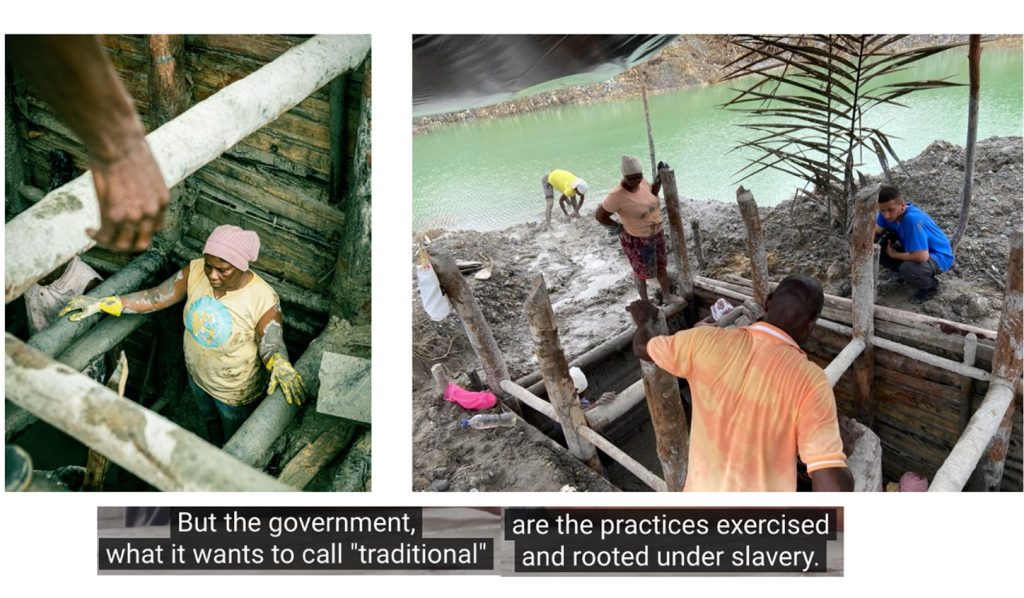
The final episode focuses on an artisanal Afro-Chocoan mining technique called the guache (wu-a-tché) pits. This practice uses endemic woods to create tunnels and mine gold-rich soils in groups of 5-15 people. The first segment in the episode describes these guache pits, how people work together, their roles, and how gold-rich soils are distributed among the crew. There is also a lively exchange about the small machines that have become part of the mining assemblage, like water pumps and pulleys that aid the miners in performing their already arduous labor.
Today, the state’s mining agency uses a narrow definition of the notion of artisanal to exclude all types of machinery and, therefore, classify guache pits as underground mining, which is subject to occupational health and safety standards (usually applicable only to larger companies). This means that people working at the guache pits are now being asked to implement work safety protocols and pay for social security benefits like healthcare and pensions. The participants critique the government’s tendency to define artisanal “as in the times of slavery” rather than create a unique classification to accommodate the needs of Black artisanal miners working underground.
The conversation also explains that excavators reconfigured the collective work dynamics when they first arrived. Mechanization made the flow of gold dividends easier to flee the surrounding Black communities, and it affected artisanal mining families the most. Since the machinery owners and the land owners used these underground mines as markers for the presence of gold, the episode highlights that the hard physical labor of Afro-Chocoans materially facilitated the looting of gold by diesel-powered excavators owned by white mestizo investors in other parts of Colombia. Local Afro-Chocoans celebrating mining deals obviously benefited by receiving a portion of the yields. Still, the process severely impoverished the collective artisanal economies and the families that depended on them.
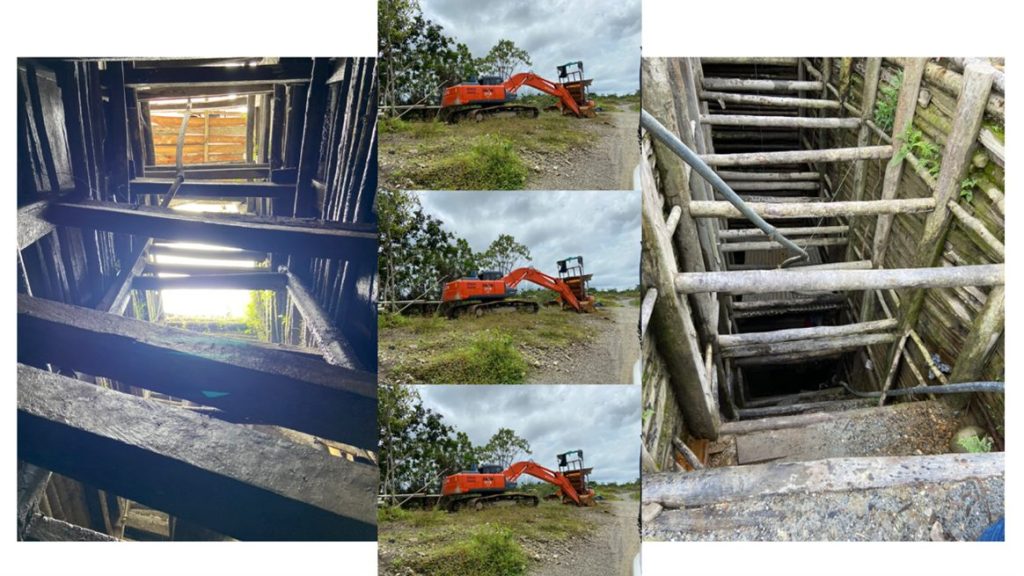
The micro-politics of the guache pits will resonate with Afro-Chocoans and other Black peoples of the African diaspora whose livelihoods depend on mining and whose children and grandchildren have become mining engineers to honor their ancestral legacy. The conversation weaves together the voices of four men who know the guache pits through different practices. The older two men mined the guache pits and lived off their gold dividends since they were children. The younger two men have studied the guaches and learned to speak on their behalf in critical dialogue with the Colombian government. They complement each other’s views and debate one another. Such is the magic of the territorial video podcast. It is an encounter among participants and a coherent set of voices and perspectives on the same issue, even if they disagree. That’s when nuances emerge.

Coda
Academics in political ecology and development geography, myself included, often get into heated debates about romanticizing “community”, social movements, and water justice. We are especially critical of the practices and discourses that attempt to “make the subaltern speak” (for an overview, see Asher 2013). After this territorial video podcast, much of that debate evaporated through the meaningful connections we built with grassroots organizers and the people mining and living their campesinx lives. I insist that we can conduct a rigorous study of capitalist contradictions, extractive governmentality, and racialized and neocolonial development and tune to (and support) the hopes, dreams, and aspirations of people who co-constitute these phenomena as they participate in popular economies.
We, the co-producers, believe Deep Bonds adds valuable conversations that connect with the already powerful work of destabilizing geographies in Colombia (Ulloa 2024) and creatively respond to the call to theorize a river-as-subject ontology (Boelens et al. 2020). However, rather than assume that the river-as-subject offers “decolonizing transformative change”, we say:
Something very deep is woven through the fabric of our bodies,
It is a fiery roar that connects with the roots of our ancestral legacy,
They are bonds and re-existences that dig, sow, and write poems.
Some of these bonds remain problematic, while others offer much room for combat. Our contribution to radical geography is fleshing out some of these unsurmountable co-implications in a small portion of the Chocó along the upper Atrato River basin. We are incredibly grateful to the Antipode Foundation for allowing us to share these perspectives with the anglophone world. Please find us on YouTube as “Lazos Profundos” (https://www.youtube.com/@LazosProfundosPodcast); like, subscribe, and activate the English subtitles. Share this piece with anyone struggling with the same issues, and let us know where we might find independent funding for the next season at [email protected]

References
Agencia Nacional de Minería (2025) “Participación ciudadana fortalece decisiones mineras en Chocó.” Press release, 29 March https://www.anm.gov.co/participaci%C3%B3n%2Aciudadana%2Afortalece%2Adecisiones%2Amineras%2Aen%2Achoc%C3%B3 (last accessed on 7 April 2025)
Asher K (2013) Latin American decolonial thought, or, Making the subaltern speak. Geography Compass 7(12):832-842
Atico Mining Corporation (2025) “El Roble Mine—Snapshot.” https://aticomining.com/el-roble-mine/snapshot/ (last accessed 7 April 2025)
Boelens R et al. (2023) Riverhood: Political ecologies of socionature commoning and translocal struggles for water justice. Journal of Peasant Studies 50(3):1125-1156
Cabnal L (2010) Acercamiento a la construcción de la propuesta de pensamiento epistémico de las mujeres indígenas feministas comunitarias de Abya Yala. In ACSUR-Las Segovias (eds) Feminismos diversos: El feminismo comunitario (pp10-25). Madrid: ACSUR-Las Segovias
Cabnal L (2013) Defender un territorio de la minería sin defender a las mujeres de la violencia sexual es una incoherencia. Periódico Diagonal 23 May https://www.diagonalperiodico.net/global/defender-territorio-la-mineria-sin-defender-cuerpos-mujeres-la-violencia-sexual-es (last accessed 22 May 2025)
Colectivo Miradas Críticas del Territorio desde el Feminismo (2017) Mapeando el Cuerpo-Territorio: Guía metodológica para mujeres que defienden sus territorios. Quito: Diakonia & Misereor
Corporación Jurídica Libertad (2021) “Ríos de Mujeres. Liderazgo de mujeres en defensa del territorio y afectaciones diferenciales por la implantación de pequeñas centrales hidroeléctricas en el Oriente antioqueño.” https://cjlibertad.org/wp-content/uploads/2022/02/Ríos-de-mujeres-version-digital.pdf (last accessed 22 May 2025)
Cuerpo Colegiado de Guardianes del Atrato, Centro Sociojurídico para la Defensa Territorial—Siembra, Núñez D and Espinosa J D (2024) “Un río con derechos: A SON DE QUÉ.” https://www.youtube.com/watch?v=ZHiC9V4Uf_g (last accessed 22 May 2025)
Gago V (2020) Feminist International: How to Change Everything (trans L Mason-Deese). New York: Verso
Gilmore R W (2017) Abolition geography and the problem of innocence. In G T Johnson and A Lubin (eds) Futures of Black Radicalism (pp225-240). New York: Verso
Melo-Ascencio D (2024) A postcolonial Marxist critique of the river-as-subject: Situating the Atrato River in its development aporias. Antipode 56(5):1754-1774
Melo-Ascencio D (forthcoming) Alluvial gold exploitation along the Quito River: Dredgers and the operations of racial capitalism through social reproduction. Environment and Planning D: Society and Space
Montes G (2025) El millonario pleito que le ganó Chocó en medio de su crisis a una poderosa minera. El Espectador 11 March https://www.elespectador.com/judicial/el-millonario-pleito-que-le-gano-choco-en-medio-de-su-crisis-a-una-poderosa-minera-noticias-hoy/ (last accessed 22 May 2025)
Mosquera B (2019) Inventario de técnicas de minería de oro en el Departamento del Chocó. In Tierra Digna (eds) Risas, sueños y lamentos del río: Vivencias de los ríos Atrato y Baudó desde la mirada de sus guardianas (pp55-61). Bogota: Centro de Estudios para la Justicia Social—Tierra Digna
Patel R and Moore J W (2018) A History of the World in Seven Cheap Things: A Guide to Capitalism, Nature, and the Future of the Planet. Oakland: University of California Press
Siembra (2024) “Las deudas del cobre en el Carmen de Atrato: Un examen al proyecto minero El Roble.” Centro Sociojurídico para la Defensa Territorial—Siembra https://www.centrosiembra.org/2025/03/14/las-deudas-del-cobre-en-el-carmen-de-atrato-un-examen-al-proyecto-minero-el-roble/ (last accessed 22 May 2025)
Ulloa A (2024) Destabilising geographies in Colombia: Trajectories and perspectives. Transactions of the Institute of British Geographers 49(2) https://doi.org/10.1111/tran.12588