Simone Tulumello (Instituto de Ciências Sociais, Universidade de Lisboa)
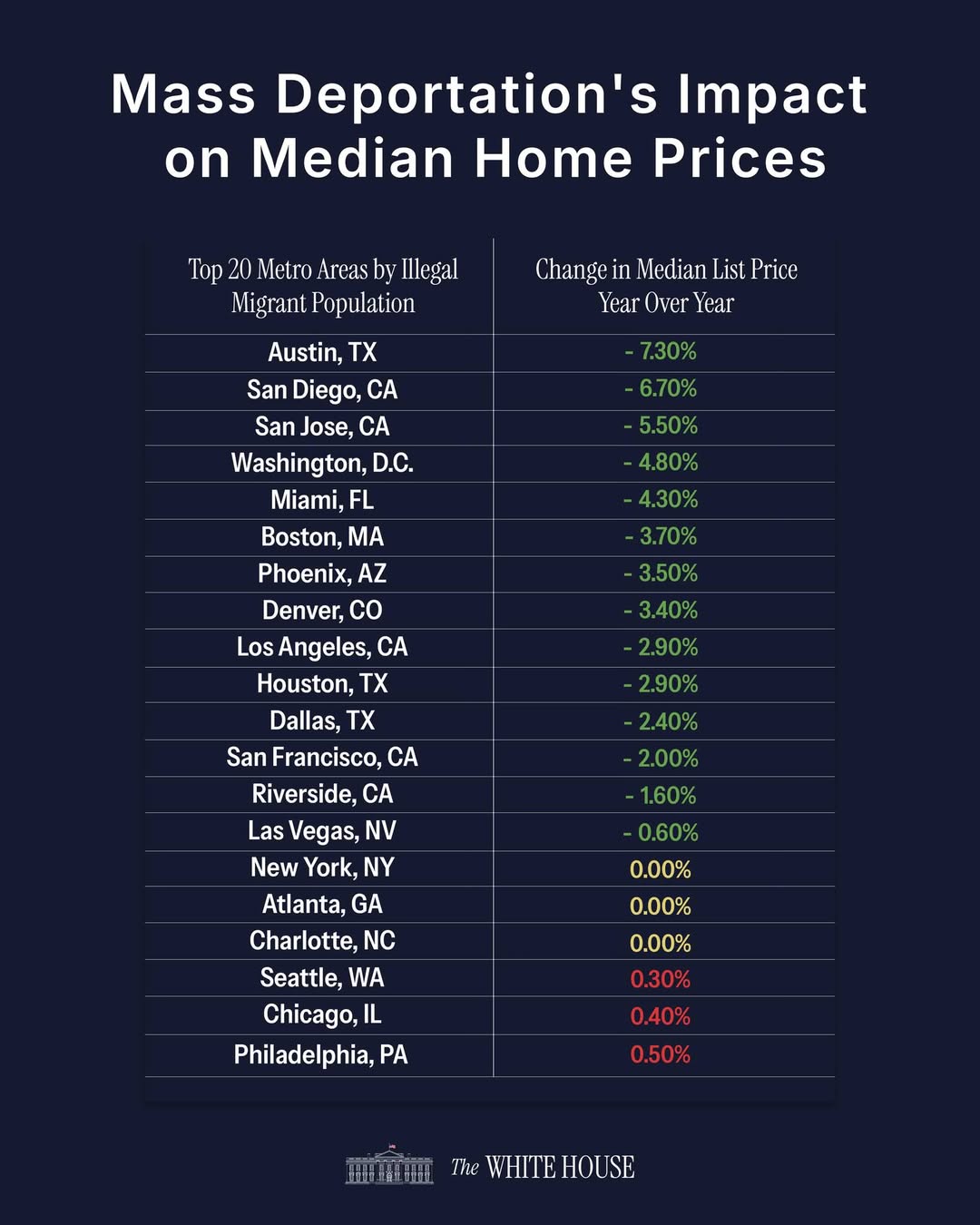
On January 14, 2026, the official Facebook account of The White House published a table with a list of the “Top 20 [US] metro areas by illegal migrant population”, organized by the “change in [housing] median list price” during the last year. On top stands Austin, TX, where prices dropped by 7.30%; on the bottom, Philadelphia, PA, where prices increased by 0.50%. The post accompanying the table reads:
Mass deportations = lower housing costs.
In 14 of the top 20 cities with the largest illegal migrant populations, home list prices DROPPED year-over-year in December. The only 3 seeing slight increases? All sanctuary cities.
As US citizens are growing increasingly sceptical that Trump’s administration is actually “good for the economy”—or, at the very least, good for those dimensions of “the economy” that matter for most people—it should be no surprise that the White House tries to justify its murderous border and immigration enforcement policy on economic grounds. “We kick migrants out,” the not so implicit message is, “housing gets cheaper.” Win-win, from the viewpoint of the intersection of fascist-wannabes and bread-and-butter Republicans.
Pointing out the absurdities and contradictions of the message is quite too simple. The comments below the Facebook post make a pretty good job at the economics 1.01 of the issue: correlation is not causation, stupid; there are other supply/demand factors, right? Someone even points to the risky nature of the political message, for conservatives, as dropping property values are historically not loved by the overwhelmingly proprietary constituency of the Republican party. And so on and so forth.
One can even be more nuanced than that. Say, in Austin, housing prices did drop recently because of a supply boost, but as a result of a very specific local situation: for a long time, restrictive zoning regulations, designed to keep the poor (and the African-American, and the Latino, and the immigrant…) away from middle- and high-class neighbourhoods and suburbs, made the building of affordable housing impossible; the recent abolition of those regulations allowed not only to build more housing, but also, and that’s almost certainly what brough prices down, to build housing for lower market segments. And this is why European economists and liberals crying that housing prices would drop if we only liberalized planning regulations literally don’t know what they are talking about—there is very little, in fact almost nothing, like US-exclusionary zoning, at least in terms of its impacts on housing supply, across European cities.
But for all the nuances, I would submit, it is the very liberal/economicist nature of these counter-arguments that make them deeply problematic. They exchange a good “a-ha” moment—“stupid Trumpists, we got y’all!”—for the acceptance of the basic assumption of the Trumpist argument. By replying “correlation is not causation”, one is fundamentally accepting the driving logic that links fascist border policies to the prices of a commodity called housing. One is, on the one hand, admitting the possibility of giving economic value to mass deportation: it may not work with housing, Trumpists could easily reply, but it will certainly work with other goods—less demand is less demand, after all. And, on the other hand, one is accepting the economy of housing as being determined by supply-meets-demand logics. In other terms, it is a fundamental failure because it means accepting the liberal economics of housing-as-commodity determined by supply/demand. You cannot respond to fascist imaginaries with liberal fantasies. Or, if you prefer, the only worse thing of raw necropolitics Trump-style is the liberal economicization of necropolitics. “Well, deporting folks is quite bad, but what if it really made housing prices go down?” is the creeping question that immediately follows. It is, by the way, the same logic that brought some economists to the point of calculating the pros and cons of torture. To hell with it.
The only decent reply is pretty simple and, by the way, much more consequential in terms of housing affordability: we don’t give a heck if mass deportation makes the commodity of housing cheaper. We just do not discuss the economics of mass deportation; we fight it to the last bit of strength. And, to the liberal economy of housing-as-commodity, we reply with the political economy of housing-as-right: housing must (and will) be decommodified, period, so that rentists cannot speculate on migration or whatever else. Amid socialism, there are no housing prices to be pushed up or down by migration or deportation. That’s pretty much it.