Federico Ferretti (University of Bologna)
Guilherme Ribeiro (Federal Rural University of Rio de Janeiro)
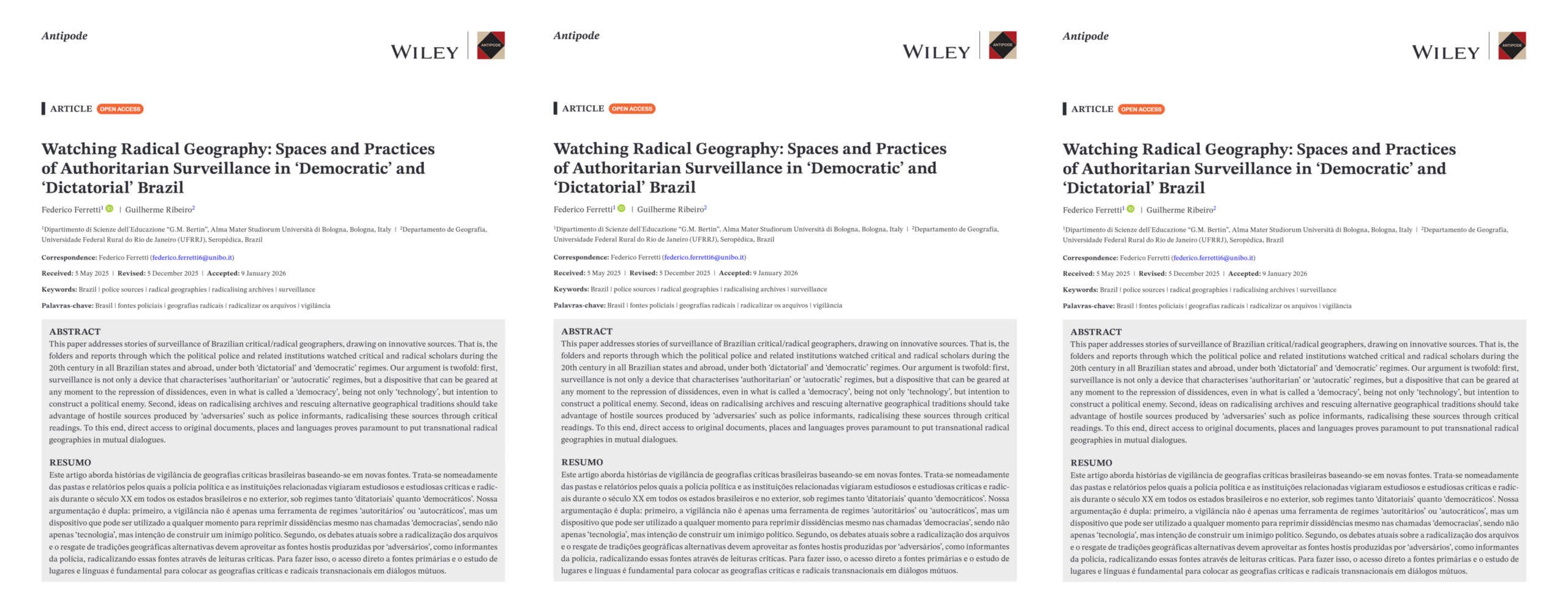
As part of the ethical, political and pedagogical commitment that has been mobilizing part of the international geographic community to value languages other than English, the following paragraphs highlight, in bilingual version, some aspects of the article “Watching Radical Geography: Spaces and Practices of Authoritarian Surveillance in ‘Democratic’ and ‘Dictatorial’ Brazil”, published in volume 58 of Antipode in January of this year.
After almost four hundred years of slavery between 1500 and 1888—whose pernicious effects in terms of racism, violence and inequality structure Brazilian society to this day—Republican Brazil suffered two authoritarian coups in the twentieth century. The first, known as the Estado Novo (1937-1945), closed the Congress and imprisoned novelists, intellectuals and politicians opposed to the fascist-inspired regime led by Getúlio Vargas. To do so, two government agencies were essential: the police branch called the Department of Political and Social Order (DOPS) and the intellectual branch called the Department of Press and Propaganda (DIP). Founded in this context, the National Council of Geography (1937), the Revista Brasiliera de Geografia (1939) and the Boletim Geográfico (1943) tried to control the geographical discourse in order to avoid criticism of the government and to reproduce the image of a country without social contradictions (Ribeiro 2024).
This experience left marks as current literature related to surveillance studies understands that surveillance is a constituent part of the modus operandi of capitalist states in general, although, in the Brazilian case, it is impossible to compare the surveillance exercised by authoritarian regimes and its practical consequences with what occurred during democratic regimes. However, even after the reestablishment of democracy, the Brazilian State continued to employ its intelligence service. After the second coup, the military deposed the elected president, João Goulart, in 1964. With the establishment of the National Information Service (SNI) in the same year and the Institutional Act n.5 (AI-5) in 1968, the suppression of the rule of law was accompanied by a network of military personnel from the Army, Navy and Air Force acting as spies in all states of the federation.
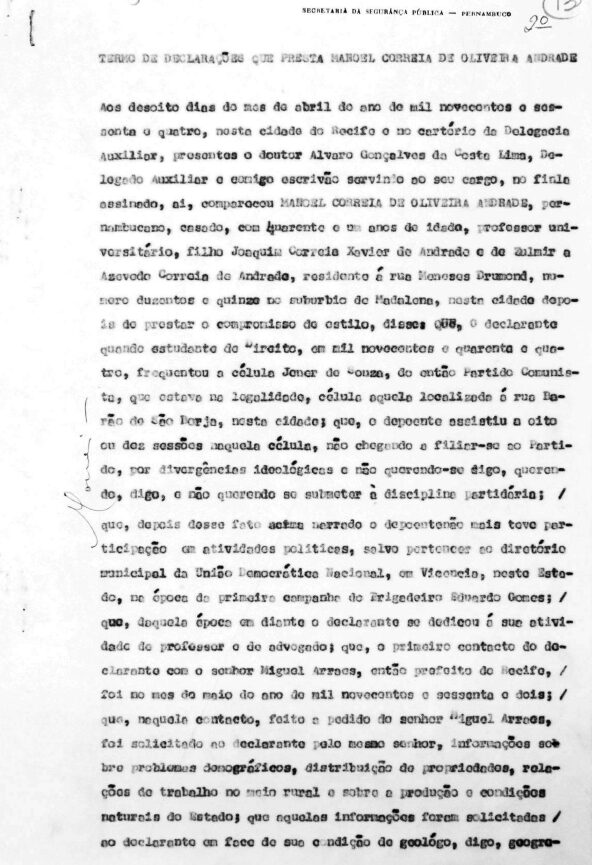
As we could see in the archives, it was a highly capillary network, which implied for instance that the same document could be disseminated among various organs, which accelerated the process of classifying “subversives” and “communists”—two very recurrent signifiers in the neurotic-ideological lexicon of the military personnel responsible for the preparation of papers and dossiers against people persecuted by the dictatorship. In the context of the Cold War, when Brazil was aligned with the geopolitical Bloc led by the United States, the “fight against communism” became the perfect alibi to justify all types of surveillance and violence—the latter not only physical, but also symbolic. Indeed, the censorship of books, films, music and plays ran through the entire regime.
Among the “enemies of the homeland”, the best-known geographers are Josué de Castro, Milton Santos and Manuel Correia de Andrade: in exile, the first two analysed hunger and geopolitics, urbanization and underdevelopment on the national and international scales. The third, who focused on social movements fighting for land, had his career completely upset by the regime of exception. Eventually, Andrade was imprisoned both by the Estado Novo and by the civil-military dictatorship. Castro died after constantly suffering the sadness of being far from his country in 1973. Santos only came back to Brazil thirteen years after his departure (1977), when the regime was beginning to lose strength and the economy was going from bad to worse (Ferretti 2018; Ferretti and Pedrosa 2018).
Focusing on the cases of the Federal University of Pernambuco and the University of São Paulo, as they were innovatively addressed through primary police sources, our article invites us to reflect on four matters:
a. the first concerns the fact that, from a critical point of view, the trajectory of several Brazilian geographers in particular and the development of Brazilian geography in general must be understood in their connections (still insufficiently explored) with the two authoritarian periods that devastated the country;
b. the second, of a methodological nature, raises interpretative challenges on dealing with highly biased materials that reflect much more the worldview of the spies than the practices and ideas of the geographers under surveillance;
c. the third highlights the dangers and anxieties of students, professors and researchers who, even though they were aware of living in a violent regime, tried, to the limit of their strength, to practice a geography of resistance that did not close their eyes to the social and political reality of the country;
d. the fourth and final matter underlines the need for critical geographers to contribute to public discussions about the memory of the dictatorship. Although unbelievable, military personnel directly involved in torture and harassment still try to defend the regime and its criminal acts. Very recently, last year, historian Francisco Carlos Teixeira da Silva, a full professor at UFRJ famous for his critical studies on the military, fascism and the right-wing political spectrum in the contemporary era, was incriminated in court for “slander, defamation and falsification of history” by retired general Álvaro Pinheiro, in addition to receiving anonymous threats (see the AdUFRJ website).
In other words: today and yesterday, human and social sciences continue to denounce inequalities and abuses of power and, consequently, to disturb the status quo.
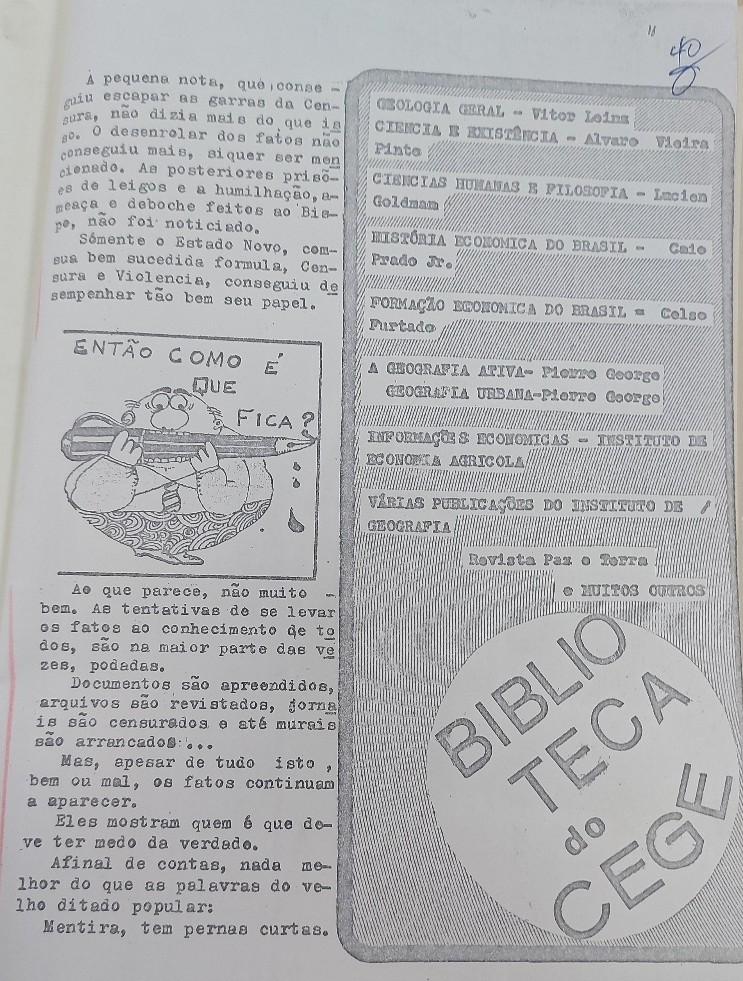
Connected all day long on social networks, the young generation of geographers should not believe that the Estado Novo, and much less the civil-military dictatorship from 1964 to 1985, belong to a distant past. Quite the opposite. After all, one of the effects of these experiences is the resurgence of the Far Right in Brazil and in several places around the world—this time, instead of military coups, the strategy is to take advantage of democratic systems and occupy parliamentary and presidential positions with the aim of destabilising them.
Therefore, in the name of Josué de Castro, Manuel Correia de Andrade, Milton Santos and so many other anonymous geographers who fought against the regime of exception, the defence of public rights and liberties, of freedom of expression and of an egalitarian society must remain as a motivator of our political and intellectual praxis today.
References
Ferretti, F. 2018. “Geographies of internationalism: Radical development and critical geopolitics from the Northeast of Brazil.” Political Geography 63:10-19. https://doi.org/10.1016/j.polgeo.2017.11.004.
Ferretti, F. and Pedrosa, B. 2018. “Inventing critical development: A Brazilian geographer and his Northern networks.” Transactions of the Institute of British Geographers 43(4):703-717. https://doi.org/10.1111/tran.12241.
Ribeiro, G. 2024. “O efeito DIP e a ordem do discurso geográfico: censura, nacionalismo e território na Revista Brasileira de Geografia durante o Estado Novo (1939-1945).” Revista da Anpege 20(42):3-37. https://doi.org/10.5418/ra2024.v20i42.19161.
* * *
Federico Ferretti (Universidade de Bologna)
Guilherme Ribeiro (Universidade Federal Rural do Rio de Janeiro)
Como parte do compromisso ético, político e pedagógico que vem mobilizando parte da comunidade geográfica internacional em direção a outros idiomas para além do inglês, os parágrafos seguintes se propõem a chamar atenção, em versão bilingue, para alguns aspectos do artigo “Watching Radical Geography: Spaces and Practices of Authoritarian Surveillance in ‘Democratic’ and ‘Dictatorial’ Brazil”, publicado no volume 58 da revista Antipode em janeiro do presente ano.
Após quase quatrocentos anos de escravidão entre 1500 a 1888—cujos efeitos perniciosos em termos de racismo, violência e desigualdade estruturam a sociedade brasileira até hoje—no século XX o Brasil Republicano sofreu dois golpes autoritários: o primeiro, conhecido como Estado Novo (1937-1945), fechou o Congresso e prendeu romancistas, intelectuais e políticos contrários ao regime de inspiração fascista comandado por Getúlio Vargas. Para fazê-lo, dois órgãos governamentais foram essenciais: o braço policial chamado Departamento de Ordem Política e Social (DOPS) e o braço intelectual nomeado Departamento de Imprensa e Propaganda (DIP). Fundados neste contexto, o Conselho Nacional de Geografia (1937), a Revista Brasileira de Geografia (1939) e o Boletim Geográfico (1943) tentavam controlar o discurso geográfico de maneira a evitar críticas ao governo e a reproduzir uma imagem de um país sem contradições sociais (Ribeiro 2024).
Esta experiência deixou marcas e, mesmo após o restabelecimento da democracia (a literatura atual relacionada aos surveillance studies entende que a vigilância é parte constituinte do modus operandi dos Estados capitalistas em geral, muito embora, no caso brasileiro, é impossível comparar a vigilância exercida pelos regimes autoritários e suas consequências práticas com aquela ocorrida durante regimes democráticos), o Estado brasileiro continuou a empregar seu serviço de informações. Após o segundo golpe, os militares depuseram do poder o presidente eleito, João Goulart, em 1964. Com o estabelecimento do Serviço Nacional de Informações (SNI) no mesmo ano e do Ato Institucional n.5 (AI-5) em 1968, a supressão do Estado de Direito veio acompanhada de uma rede de militares do Exército, Marinha e Aeronáutica atuando como espiões em todos os estados da federação.
Tal como pudemos verificar nos arquivos, estamos diante de uma rede altamente capilarizada, característica esta que fazia com que um mesmo documento fosse disseminado por entre vários órgãos e, assim, acelerasse o processo de classificação dos “subversivos” e “comunistas”—dois significantes bastante recorrentes no léxico neurótico-ideológico dos militares responsáveis pela confecção de papéis e dossiês contra os perseguidos pela ditadura. Na conjuntura da Guerra Fria, quando o Brasil estava alinhado às diretrizes geopolíticas lideradas pelos Estados Unidos, a “luta contra o comunismo” transformou-se no álibi perfeito a justificar todo e qualquer tipo de vigilância e violência—esta última não apenas física, mas, também, simbólica. Afinal de contas, a censura a livros, filmes, músicas e peças teatrais atravessou todo o regime.
Dentre os “inimigos da pátria”, os mais conhecidos geógrafos são Josué de Castro, Milton Santos e Manuel Correia de Andrade: no exílio, os dois primeiros analisaram a fome e a geopolítica, a urbanização e o subdesenvolvimento nas escalas nacional e internacional, enquanto o terceiro, concentrado sobre movimentos sociais em luta pela terra, teve sua carreira prejudicada como um todo pelo regime de exceção. De Andrade, por exemplo, foi preso tanto pelo Estado Novo quanto pela ditadura civil-militar; De Castro morreu desgostoso longe do seu país em 1973; e Santos só retornou ao Brasil treze anos após sua saída (1977), quando o regime começava a perder forças e a economia ia de mal a pior (Ferretti 2018; Ferretti e Pedrosa 2018).
Concentrando-se sobre os casos da Universidade Federal de Pernambuco e da Universidade de São Paulo, por ter sido elaborado de forma inovadora a partir de fontes primárias policiais, o artigo em tela nos convida a refletir sobre quatro questões:
a. a primeira diz respeito ao fato de que, do ponto de vista crítico, a trajetória de vários geógrafos brasileiros em particular e o desenvolvimento da geografia brasileira em geral devem ser entendidas em suas conexões (ainda insuficientemente exploradas) com os dois períodos autoritários que assolaram o país;
b. a segunda, de corte metodológico, levanta desafios interpretativos ao lidar com materiais altamente discriminatórios e que refletem muito mais a visão de mundo dos espiões que às práticas e idéias dos geógrafos vigiados;
c. a terceira ressalta os perigos e as angústias de estudantes, professores e pesquisadores que, mesmo cientes de viverem em um regime violento, tentaram, no limite de suas forças, praticar uma geografia da resistência que não fechasse os olhos para a realidade social e política do país;
d. a quarta e última questão sublinha a necessidade dos geógrafos críticos de contribuirem nas discussões públicas sobre a memória da ditadura, pois, embora seja inacreditável, militares diretamente envolvidos em torturas e assédios ainda tentam defender o regime e seus atos ilegítimos. Bem recentemente, ano passado o historiador Francisco Carlos Teixeira da Silva, professor titular da UFRJ e famoso por seus estudos críticos sobre militares, fascismos e o espectro político da direita na era contemporânea, foi incriminado na Justiça por “calúnia, difamação e falsificação da História” pelo general da reserva Álvaro Pinheiro, além de receber ameaças anônimas (cf. o site da AdUFRJ).
Ou seja: hoje e ontem, as ciências humanas continuam a denunciar desigualdades e abusos do poder e, por conseguinte, a incomodar o status quo.
Conectada o dia inteiro nas redes sociais, a jovem geração de geógrafos não pode pensar que o Estado Novo e, muito menos, a ditadura civil-militar de 1964 a 1985, pertencem a um passado longínquo. Muito pelo contrário. Afinal, um dos efeitos destas experiências é o ressurgimento da extrema-direita no Brasil e em vários lugares do mundo—desta vez, no lugar de golpes militares, a estratégia é aproveitar-se dos sistemas democráticos e ocupar cargos parlamentares e presidenciais com o objetivo de desestabilizá-los.
Portanto, em nome de Josué de Castro, Manuel Correia de Andrade, Milton Santos e tantos outros geógrafos e geógrafas anônimos que lutaram contra o regime de exceção, a defesa dos direitos e das liberdades públicas, da liberdade de expressão e de uma sociedade igualitária deve permanecer como motivadora de nossa práxis política e intelectual na atualidade.
Referências
Ferretti, F. 2018. “Geographies of internationalism: Radical development and critical geopolitics from the Northeast of Brazil.” Political Geography 63:10-19. https://doi.org/10.1016/j.polgeo.2017.11.004.
Ferretti, F. e Pedrosa, B. 2018. “Inventing critical development: A Brazilian geographer and his Northern networks.” Transactions of the Institute of British Geographers 43(4):703-717. https://doi.org/10.1111/tran.12241.
Ribeiro, G. 2024. “O efeito DIP e a ordem do discurso geográfico: censura, nacionalismo e território na Revista Brasileira de Geografia durante o Estado Novo (1939-1945).” Revista da Anpege 20(42):3-37. https://doi.org/10.5418/ra2024.v20i42.19161.