Introduction — “Border Spectacles and Carceral Power:
Deportation, Detention and Struggle Across Geographies”
Cemile Gizem Dinçer (Center on Forced Displacement, Boston University)
& Eda Sevinin (Mor Çatı Women’s Shelter Foundation, Turkey)
Deportation and detention have become central infrastructures of contemporary border governance as well as state-making endeavors. While not new, they are increasingly made visible and staged as public spectacles that both respond to and actively fuel nationalism and racism (Brown 2010). Through this spectacularization, deportation and detention function to regulate, contain, and discipline human mobility while structuring time and space. Today, perhaps more than ever, detention and deportation have become the political tools that nation-state governments proudly propagate and implement. New detention centers are built; new legal arrangements for hotspot deals are on the electoral agendas of right-wing, as well as centrist, parties; incumbent governments pride themselves on annual deportation numbers; state violence through and beyond carceral methods is openly perpetrated against migrants. Creating an ever-growing regime, they go beyond being mere tools of migration control; they turn into political, conceptual, economic, and spatial constellations that are deeply ingrained with the contemporary political regimes.
Detention and deportation serve internally and externally. They not only halt the unsanctioned mobility of unwanted (and racialized) populations, but they also normalize the incarceration of and state violence against certain populations. They geographically, temporally, and affectively separate human groups based on their categorization of legality/illegality. All these immobilizing technologies extend well beyond nation-state borders; they proliferate both within and beyond nation-states, are adapted by other regimes in various geographies, and transform the space and the politics within which we live. Moreover, although detention and deportation are seen as individual measures taken against migrants, they have a great impact on communities. They intercept any social, political, and economic communication and cooperation between the detainees and the communities; they cut remittances sent back to the countries of citizenship; and they work as disciplinary power for everyone (detainee or non-detainee alike) as it, at times violently, suppresses political agency and legal existence.
All of this considered, we see this interview series (which grew out of the “Global Detention and Deportation Workshop” held in Istanbul on January 9, 2026, and supported by the Center on Forced Displacement at Boston University) as a practice that helps us collectively think through our political present. This interview series brings together conversations with activists and scholars in order to discuss and make sense of global deportation and detention regimes, beyond the nation-state framework. We set out to collectively examine how human mobility, borders, social movements, and labor relations unfold when examined through the perspective of detention and deportation. This required us to think through new questions, inquire into new concepts, and ask uncomfortable questions—primarily, to ourselves.
Rather than taking nation-states as the unit of analysis, the series seeks to move beyond methodological nationalism by foregrounding the interconnected landscapes of detention and deportation and the relations between diverse geographies in which they operate. This means not only pointing to commonalities in seemingly distinct and “far away” geographies, but also paying attention and revealing the asymmetric relations that made detention and deportation the key technologies of migration regimes transnationally. The similarities observed across the different geographies addressed in the interviews are not the result of abstract comparison between geopolitical contexts. On the contrary, they point to the consistency between border regimes, the similarities between criminalization and securitization narratives in different geographical contexts, and the transnational/transhistorical linkages among them.
As in all geographies, borders, through detention and deportation, function to uphold state sovereignty, reinforce racial inequalities, serve capitalist interests, and sustain cis-heteropatriarchy. And current discourses on migrants and migration, by seeing borders as natural and necessary, justify the criminalization of refugees and legitimize the securitization of migration and borders. This, in turn, increases the expansion of detention and deportation policies, strengthens the immigrant incarceration and detention industrial complex, which generates profit not only for the government but also for private companies and individuals (Martin 2024).
Borders, contrary to their performative claims, do not aim to stop the movement of all people or exclude all people from state territories. Rather, they selectively include people, sometimes through different categorizations (refugee/asylum seeker, green card holder/citizens) and sometimes through “deservingness” and “illegalization”, creating different levels of vulnerability and precarity. It is about “civic stratification” (Coleman and Kocher 2011) which means the severance of physical presence from legal presence by way of legal exclusion (Kurz 2012). Whether in Turkey, Italy, the UK, Iran, Sweden, Greece, or the US, borders continue to create the conditions for exploitation through filtering practices of inclusion and exclusion, hierarchies based on race and gender, and illegalities produced from mobilities.
Perhaps, borders manifest their filtering capacity most in detention and deportation. “Practices of detention reify borders between citizens and non-citizens, producing categories of legality and illegality, alien and non-alien. Microspaces and processes within spaces of detention further demarcate and differentiate detainees while punishing and controlling migrant bodies” (Mountz et al. 2013: 530). Demarcation by detention goes well beyond spatial segregation. It intertwines with other normative discourses, most often gendered and racialized. As Francesca Esposito illustrates, the narrative of “good/acceptable” women “represents” women as victims, while legitimizing the detention or deportation of “bad” women. This depiction alludes to “the problem of innocence” (Gilmore 2022), a logic that only serves to justify the confinement and expulsion of others, a dynamic that is spectacularly evident in contemporary state discourses that invoke “criminals” and the “worst of the worst” to legitimize deportation and detention. As criminalization intensifies, incarceration expands and carceral spaces proliferate.
It’s widely argued that deportation and detention became one of the prominent features of the geopolitics of migration control, but they are also key spaces of resistance and organizing. Focusing on the spaces of expulsions and carcerality not only draws attention to spaces of confinement but also to practices of movement, allowing us to consider freedom to move, to stay and return (Montange 2026). From this perspective and following a central premise of abolition geography that “freedom is a place” (Gilmore 2022: 351), resistance to expulsion and confinement emerged through the making of spatial configurations.
Under conditions of escalating repression against political activism, context where detention and deportation regimes go hand-in-hand with anti-migration politics that receive broader popular support, organizing against deportation and border regimes and building solidarity becomes increasingly harder. Nonetheless, anti-border, anti-detention/deportation movements as well as abolitionist movements emerge, grow, and multiply around the world. Since anti-immigrant sentiments, anti-gender regimes, racist nationalisms, and fascisms increase around the world, we should also trace “topographies of hope” (Katz 2023), new concepts to understand current power dynamics and hope to unearth new tools to unsettle border and deportation regimes from within and beyond. This also requires revisiting the history of resistance, tools and concepts we have developed so far, approaching them critically, and remaining aware of the illusions produced by liberal solutions. As Thomas Kemp highlights in this series, this sometimes means being aware of the limits of representational politics, especially in cases of detention where the detainees are deprived of their own voices and of rethinking the possibilities of post-representational politics. At other times, as Detention Landscapes project team and Hayriye Kara and Mehtap Erdem remind us, it means recognizing the risks of sectoralization, compartmentalization, and professionalization of the field which shift the meaning of solidarity, depoliticize the inherently political field of detention and deportation, and undermine the advocacy and voluntary work that consists of a vast part of the struggle. Therefore, it is time to recall the collective memory of struggle—from migrant self-organization and solidarity networks to anti-border movements and detention and border abolitionism.
Tracing the possibilities of supporting political struggles also demands a critical interrogation of knowledge production itself. As Shahram Khosravi reminds us, engaging with deportation and detention regimes also requires confronting a set of uncomfortable questions: Given the covert and clandestine nature of practices of detention and deportation, how are we going to “know” detention and deportation? For whom do we produce knowledge? Who needs the knowledge we produce around deportation and detention? Or how can critical scholarship and activist knowledge resist becoming complicit in the very regimes of power that they seek to analyze and dismantle? Engaging knowledge production in this way requires reflection on how detention and deportation regimes, as well as resistance against them, are deeply embedded in the political present, how these regimes spill over beyond time and space, which actors are implicated in the reproduction of these regimes, and how we can think of new ways not only to understand but also contest and dismantle them, which is also deeply related to questions of justice, and new visions of futures. As Alicia Schmidt Camacho and Stephen Pitti underline in their interview, demand for social justice means moving way more to rights-based frameworks and transgress the nation-state’s borders. As migrant justice movements and border abolitionists have been raising, it goes well beyond formal justice or redress. It, of course, means the reparation of damages done to individuals and communities by a system that denies them mobility, livelihood, safety, and even right to life. But it also calls for exposing, disrupting, and changing the system that produces borders as well as detention and deportation regimes.
What does justice look like in detention and under the constant threat of deportation? How can we engage in these justice movements from our own standpoints? What does knowledge production on detention and deportation mean in terms of demanding justice? We invite readers to think those through and ask themselves what is the world we want to live in and how do we actually want to live together. We hope these interviews have contributed to imagining radical futures and encourage work for a world where social justice is for all.
The Interviews
Introduction — Cemile Gizem Dinçer and Eda Sevinin, USA / Turkey
Shahram Khosravi, Sweden
Detention Landscapes, UK / Greece
Alicia Schmidt Camacho and Stephen Pitti, USA
Francesca Esposito, Italy
Hayriye Kara and Mehtap Erdem, Turkey
Tom Kemp, UK
References
Brown, W. 2010. Walled States, Waning Sovereignty. Zone Books
Coleman, M., and A. Kocher. 2011. “Detention, Deportation, Devolution and Immigrant Incapacitation in the US, post 9/11.” The Geographical Journal 177, no. 3: 228-237. https://doi.org/10.1111/j.1475-4959.2011.00424.x.
Gilmore, R. W. 2022. Abolition Geography: Essays Towards Liberation. Verso Books.
Katz, C. 2023. “The 2023 Antipode AAG Lecture—‘Topographies of Hope’.” Antipode Online, March 17. https://antipodeonline.org/2023/03/17/the-2023-antipode-aag-lecture/.
Kurz, J. J. 2012. “Book Review—Seeking Asylum: Human Smuggling and Bureaucracy at the Border by Alison Mountz.” Antipode 44, no. 4: 1571-1575. https://doi.org/10.1111/j.1467-8330.2011.00985.x.
Martin, L. L. 2024. “Conceptualising US Immigration Detention as Carceral Real Estate.” Antipode 56, no. 2: 558-580. https://doi.org/10.1111/anti.12992.
Montange, L. 2026. “Carceral Remains, Abolition Remains: Immigration Detention in Madrid.” Antipode 58, no. 1: e70126. https://doi.org/10.1111/anti.70126.
Mountz, A., K. Coddington, R. T. Catania, and J. M. Loyd. 2013. “Conceptualizing Detention: Mobility, Containment, Bordering, and Exclusion.” Progress in Human Geography 37, no. 4: 522-541. https://doi.org/10.1177/0309132512460903.
Eda Sevinin received her PhD in 2022 from the Department of International Relations at Central European University. Her studies mainly focused on forced migration and humanitarian relations in Turkey. After graduation, she worked in various projects that monitor migrant and refugee rights in Turkey. She is currently a social worker at Mor Çatı Women’s Shelter Foundation.
Cemile Gizem Dinçer is a feminist researcher working at the intersections of gender and migration. For more than ten years, she has conducted research on migration, borders, asylum, women’s labor, and gender, and is now working on Turkey’s expanding deportation regime from a feminist perspective. She received her PhD in Sociology from Middle East Technical University in 2022 and is currently a postdoctoral researcher at the Center on Forced Displacement at Boston University.
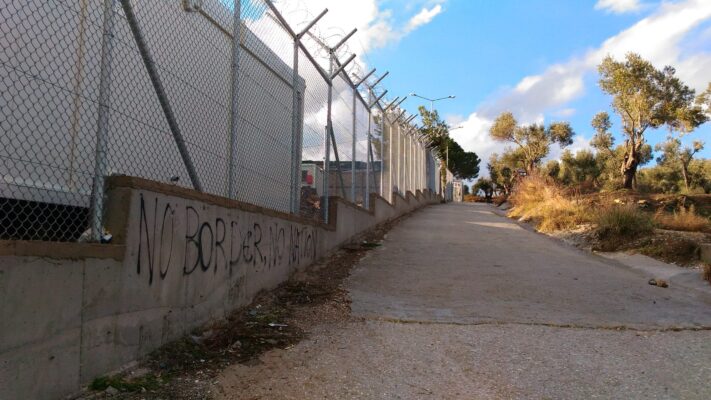
Featured image: “Outskirts of Moria camp, Lesbos, on January 15th 2017” by Catherine Lenoble via Wikimedia Commons CC BY-SA 4.0