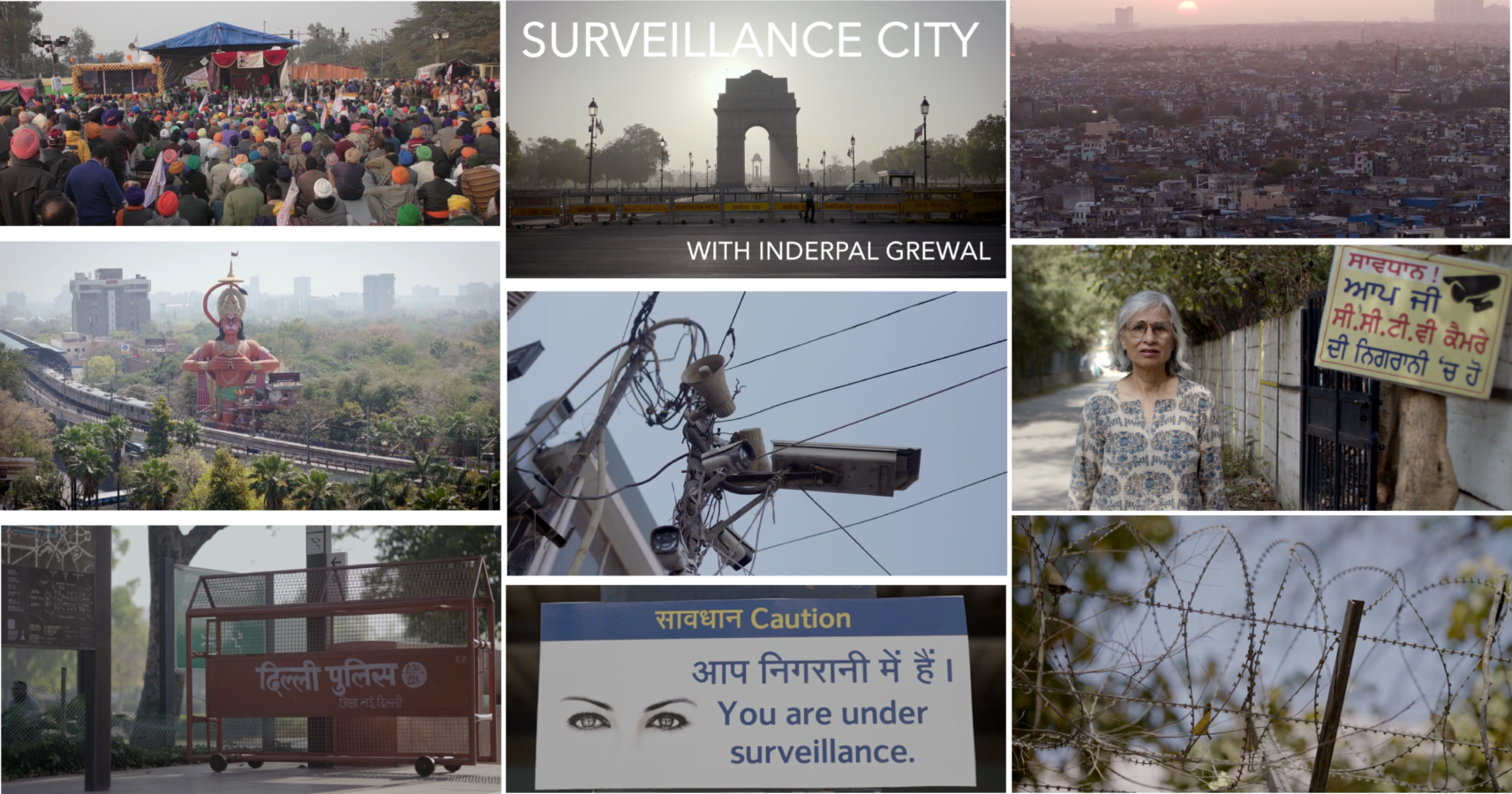
Today it’s our pleasure to present the second of the films produced following the re-launch of the Antipode Film Project in May 2023 (the first can be viewed here). The brief was to create something “to further bridge the gaps between academic scholarship and public knowledge, to provide social justice-oriented educators and activists with resources for their work, and to foster critical thinking through creative expression”.
Directed by Harjant Gill and Pearl Sandhu and featuring Professor Inderpal Grewal, Surveillance City takes viewers on a journey through contemporary Delhi, narrating a city marked by the extreme inequality resultant of decades of neoliberalism, and highlighting the insidious work of an authoritarian state deploying surveillance and securitisation measures to govern diverse populations and temper unrest. It’s a powerful meditation on masculinism and militarism, populism and patriarchy, the aesthetics and affects of security, nationalism and religion, policing and the law, discourses of terror, fear of the other, the role of the media, but also dissent, protest, and the prospects of democracy in a postcolonial state.
The trustees of the Antipode Foundation and Antipode’s Editorial Collective would like to thank Inderpal, Harjant and Pearl for their wonderful work. This is a short film of great educational, activist, and artistic value, and we invite you, the viewer, to share it widely and put it to work in your teaching, research, and beyond. Surveillance City can be viewed below. The film is accompanied a lively essay, “Delhi’s Security Aesthetics: Surveillance, Securitization, and Advanced Neoliberalism in India”, and set of further readings.
Harjant Gill is a Professor of Anthropology at Towson University and an award-winning documentary filmmaker whose work moves between ethnography and visual storytelling to explore masculinity, migration, and media in South Asia. He is the director of Roots of Love, Mardistan/Macholand, and Sent Away Boys, films that have been broadcast internationally on the BBC, PBS, and Doordarshan and screened widely in academic and public forums. His forthcoming book, Coming of Age in Macholand (University of Chicago Press), examines patriarchy, violence, and transnational migration in Indian Punjab through a deeply personal ethnographic lens. His website is https://www.harjantgill.com/
Inderpal Grewal is Professor Emeritus of Women’s, Gender, and Sexuality Studies at Yale University. She is also Professor in the Ethnicity, Race, and Migration program, the South Asian Studies Council, and affiliate faculty in the American Studies program. Grewal is one of the founders of the field of transnational feminist studies, and known for her prolific work on transnational feminism, feminist approaches to post-colonialism, diaspora and South Asian cultural studies, mobility and modernity, and human rights. She is the author of several books, including Saving the Security State: Exceptional Citizens in Twenty-First-Century America (Duke University Press, 2017).
Pearl Sandhu is a Delhi-based filmmaker with a Bachelors in Commerce from Lucknow University and a Masters in Communications from AJK Mass Communication Research Centre at Jamia Millia Islamia University. With a background in broadcast journalism, she has produced, shot, directed, and edited several documentaries on masculinity, food anthropology, cultural heritage, and LGBTQI rights advocacy. Passionate about empowering storytelling, Pearl aims to create impactful narratives that resonate with audiences and make a positive difference.
Surveillance City
Featuring Inderpal Grewal
Directed by Harjant Gill and Pearl Sandhu
Cinematography: Gurpal Singh, Kien Nguyen, Salem Khan
Music: Audio Network
Editing: Harjant Gill
Funding: The Antipode Foundation and Towson University
Special thanks: MDOCS Storytellers’ Institute, Skidmore College
Delhi’s Security Aesthetics: Surveillance, Securitization, and Advanced Neoliberalism in India
by Harjant Gill (Anthropology, Towson University), Inderpal Grewal (Women’s, Gender, and Sexuality Studies, Yale University) and Pearl Sandhu (Independent Filmmaker, Delhi)
Delhi is often understood as the capital of the world’s largest democracy. But to move through the city today is to encounter another truth: democracy is increasingly mediated through barricades, checkpoints, biometric verification, private guards, CCTV cameras, gated communities, and the language of threat to nationalist unity. In this sense, Delhi is not merely India’s capital. It is a laboratory for “advanced neoliberalism”: a political formation in which inequality is not an unfortunate byproduct of market reform, but the condition that makes securitization politically necessary (see Grewal 2017).
This is the argument that animates our short film Surveillance City. The film interrogates the ordinary spaces where security has become common sense: metro stations where passengers submit to security wands and pat-downs as a routine of urban life; shopping malls and luxury hotels where metal detectors sort bodies into the legitimate and the suspicious; elite South Delhi residential communities, referred to as “colonies”, whose gates turn public roads into semi-private enclaves; and protest sites whose shrinking geography reveals how dissent itself is managed spatially. These highly policed spaces exist alongside others that are abandoned for lack of infrastructures that enable life and livability. This companion essay extends that visual argument. It asks what Delhi can teach us about the convergence of surveillance, neoliberal restructuring, and authoritarian rule in a world increasingly disenchanted with democracy.
The story of Delhi’s transformation, and India’s transformation, into a surveillance state begins with economic liberalization in the 1990s and its impacts that have ended up reanimating some of the security logics of colonial rule. In the early aughts, this liberalization included the politics and policies of neoliberalism as it is known globally: public goods were privatized, private capital was welcomed as the engine of national advancement, and social life was reorganized around middle-class aspirations, entrepreneurship, and the possibility of economic mobility. Whatever welfare remained was tied to the need to get electoral power. Liberalization promised opportunity; it also produced spectacular inequality. That inequality is written into Delhi’s landscape: luxury compounds and office parks sit alongside precarious settlements, informal labor camps, and migrants struggling to survive. Gurgaon and South Delhi materialize one India; of wealth, privilege, and middle-class comforts. Whereas the service workers, domestic laborers, delivery workers, and migrants who move through and around those spaces inhabit another; of precarity, exploitation, and constant surveillance.
But, as we have seen around the world, inequality of this scale cannot sustain itself through markets alone. It must be protected. Here neoliberalism turns to securitization. Inderpal Grewal’s formulation of advanced neoliberalism is useful because it names the political afterlife of liberalization along with its shortcomings. “Advanced” neoliberalism is not simply about more market rule; it is the tightening alliance between privatization, authoritarian nationalism, and surveillance. As welfare retreats, policing expands. As public institutions weaken, private security proliferates. As democratic claims intensify from below, the state and its auxiliaries answer with anti-nationalism, preventive detention, biometric governance, and the constant production of fear.
Delhi illustrates how this works at the level of everyday life. The city’s security infrastructure is unevenly distributed but extensively normalized through the rhetoric of preventing crime and terrorism. Some neighborhoods remain under-policed in the sense of abandonment; others are over-policed in the name of protection. The difference is classed, caste-marked, and communalized. In elite neighborhoods, walls, guards, and cameras produce an enclave of urbanism in which affluence presents itself as vulnerability. Domestic workers, drivers, garbage collectors, and delivery workers are admitted only conditionally, after careful scrutiny. Public streets become filtered corridors. Resident Welfare Associations (RWAs) assume quasi-sovereign power, deciding who belongs, who may enter, and who counts as a risk. What is protected here is not simply property. It is social hierarchy.
Security, then, is not the opposite of insecurity. It manufactures insecurity and distributes it unevenly. The more the city is narrated as threatened, the more surveillance appears reasonable, even benevolent. This is why people consent to being searched, scanned, checked, and watched. The checkpoints become ordinary; the camera becomes invisible; the barricade becomes urban furniture. The aesthetics of securitization matter because repetition turns coercion into habit. What once might have seemed extraordinary begins to feel like the price of modern life. As the film suggests, security survives not only as policy but as atmosphere.
Patriarchy is central to this arrangement. One of the most powerful ideological justifications for fortification in Delhi is the claim that the city is “unsafe” for women. Feminist scholarship has long shown that gendered violence is often located within the home rather than outside it. Yet the securitized city depends on the figure of the dangerous outsider as the threat to middle- and upper-class/caste women: the migrant, the Muslim man, the poor Dalit man, the unverified worker, the stranger at the gate. Security discourse displaces structural gendered violence—characteristic of domesticity and patriarchy—onto racialized and communalized others, allowing the middle-class Hindu household to imagine itself as both endangered and deserving of protection. Here the patriarch at home mirrors the patriarch of the nation. Modi’s careful cultivation of himself as the “chowkidar”, the watchman looking over the nation, condenses this logic of patriarchal guardianship.
This is also why securitization in contemporary India cannot be separated from Hindu nationalism. The production of threat is never abstract. It attaches to communities. Muslims and Dalits in particular are made to bear the burden of suspicion, as if they stand outside the nation while being policed from within it. The same mechanisms extend to dissidents, students, farmers, journalists, queer activists, and others who challenge the narrowing terms of Indian citizenship. Protesters are pushed to the margins of the capital, physically distanced from the institutions they address. The state does not only repress dissent; it reorganizes urban space so that dissent becomes easier to monitor and easier to criminalize. The shrinking space of protests around Jantar Mantar—a site historically known for protestors voicing dissent on the road leading to the Indian Parliament—is one stark example of this transformation.
Digital technologies intensify these processes of surveillance and security. Universal identification databases like Aadhaar, phone-based monitoring, social media scrutiny, and the expanding fantasy of seamless biometric identification promise frictionless access for some and renewed exclusions for others. Surveillance is sold as efficiency. But efficiency for whom? The poor have long accessed the state and its meagre welfare provisions through improvised, negotiable, and sometimes fragile forms of documentation and entitlement. Biometric governance replaces those messy arrangements with a stiffer and more bureaucratically entrenched regime of verification. If older systems were susceptible to manipulation, they were also, at times, usable by the poor. New digital regimes close those gaps even as they advertise transparency. Borders, databases, and digital checkpoints thus converge in the governance of mobility.
And yet Delhi is not reducible to submission. The city is also shaped by democratic aspirations, by habits of protest, by refusals that exceed the state’s scripts. That matters politically. Advanced neoliberalism does not abolish democracy; it hollows it out while feeding on its residual legitimacy. People still go to courts, still march, still occupy streets, still imagine rights-bearing futures. Even self-censorship registers not as the death of democratic desire, but the gnawing loss of something that people believe should exist. That loss too is part of the political terrain.
Whereas Surveillance City attempts to make visible the textures of checkpoint urbanism—the iron gate, the guard booth, the pat-down, the detour, the pause before entry—this essay intends to supply the connective tissue. We argue that these are not isolated security measures, nor merely urban quirks of an unruly megacity. They are the everyday infrastructures through which inequality is secured, dissent is managed, and majoritarian belonging is territorialized in so many spaces globally.
Delhi matters because it condenses a global pattern in a particularly sharp form. Here the neoliberal promise of mobility survives beside immiseration; the tradition of democracy survives beside authoritarian practice; and surveillance survives not as an emergency measure but as a civic norm. To understand Delhi’s security aesthetic is therefore to grasp something larger: in contemporary India, security is not what remains after freedom is protected. Security is increasingly the name under which freedom is sorted, deferred, and denied.
Further Reading
Ahuja, A., and D. Kapur, eds. 2023. Internal Security in India: Violence, Order, and the State. Oxford University Press, 2023.
Al-Bulushi, S. 2024. War-Making as Worldmaking: Kenya, the United States, and the War on Terror. Stanford University Press.
Al-Bulushi, S., S. Ghosh, and I. Grewal. 2022. “Security from the South: Postcolonial and Imperial Entanglements.” Social Text 40, no. 3: 1-15. https://doi.org/10.1215/01642472-9771021.
Al-Bulushi, S., S. Ghosh, and I. Grewal. 2023. “Security Regimes: Transnational and Imperial Entanglements.” Annual Review of Anthropology 52: 205-221. https://doi.org/10.1146/annurev-anthro-052721-033213.
Amar, P. 2013. The Security Archipelago: Human-Security States, Sexuality Politics, and the End of Neoliberalism. Duke University Press.
Browne, S. 2015. Dark Matters: On the Surveillance of Blackness. Duke University Press.
Foucault, M. 2007. Security, Territory, Population: Lectures at the Collège de France, 1977-78. Translated by G. Burchell. Palgrave Macmillan.
Ghosh, S. 2023. A Thousand Tiny Cuts: Mobility and Security across the Bangladesh-India Borderlands. University of California Press.
Grewal, I. 2017. Saving the Security State: Exceptional Citizens in Twenty-First-Century America. Duke University Press.
Grewal, I. 2022. “Authoritarian Patriarchy and Its Populism.” In Cultures of Populism: Institutions, Practices and Resistance, edited by M. A. Williams, 122-141. Routledge.
Ibrahim, F. 2021. From Family to Police Force: Security and Belonging on a South Asian Border. Cornell University Press.
Keller, W. W. 2017. Democracy Betrayed: The Rise of the Surveillance Security State. Catapult.
Khalili, L. 2013. Time in the Shadows: Confinement in Counterinsurgencies. Stanford University Press.
Machold, R. 2024. Fabricating Homeland Security: Police Entanglements across India and Palestine/Israel. Stanford University Press.
Masco, J. 2014. The Theater of Operations: National Security Affect from the Cold War to the War on Terror. Duke University Press.
Monahan, T. 2010. Surveillance in the Time of Insecurity. Rutgers University Press.
Puar, J. K. 2007. Terrorist Assemblages: Homonationalism in Queer Times. Duke University Press.
Rana, J. 2011. Terrifying Muslims: Race and Labor in the South Asian Diaspora. Duke University Press.
Srivastava, S. 2022. Masculinity, Consumerism and the Post-National Indian City: Streets, Neighbourhoods, Home. Cambridge University Press.
Williams, M., and V. Satgar, eds. 2021. Destroying Democracy: Neoliberal Capitalism and the Rise of Authoritarian Politics. Wits University Press.